


You show up.
You function.
You get through the day — even if your heart feels like it’s running a marathon no one else can see.
You look fine to others. Maybe even impressive. Steady. Reliable. The friend people call when they need something. Capable. Polite.
But inside?
There’s a tension you can’t quite name. A feeling that life should feel less heavy than this. A kind of inner noise that never seems to go quiet.
If that sounds familiar — especially as you find yourself questioning alcohol, wondering about your relationship to it, or simply seeking a clearer life without numbness — you’re not alone. People who are sober curious often discover something deeper beneath their curiosity: a persistent, underlying anxiety that isn’t solved by willpower, distraction, or pretending it isn’t there.
That’s where anxiety treatment can help you more than you might expect. Not because you’re “broken,” but because you’re human — and humans aren’t meant to carry unresolved worry alone.
At Bergen County Mental Health, we help people just like you — bright, functional, sensitive, and often overwhelmed inside — understand what’s really going on beneath the surface and how to build a life that feels easier to be alive in.
First Thing: You’re Not Alone in Feeling This Way
It may feel isolating to function well outwardly while struggling inwardly. People tell you, “You seem fine.” Friends call you strong. Family might even use words like “resilient” or “stable.”
But strength is sometimes just survival without support.
An inner sense of anxiety — that subtle dread, that low hum of tension — is more common than most people realize. Many people who explore sobriety or question their drinking discover that the things they were masking weren’t just habits — they were unmet needs and unregulated emotions. When you’re tempted to reach for something to calm the panic, there’s another way forward worth exploring.
Anxiety treatment doesn’t pathologize you. It meets you right where you are — and helps you see patterns you’ve been living with quietly for years.
The Difference Between Coping and Healing
When you’re functioning well, it’s easy to confuse coping with healing. The truth is, you can keep up with life and still feel miserable underneath the performance.
Coping says:
“I can manage.”
“I can get by.”
“I have been doing this for years.”
Healing says:
“I want to feel better than this.”
“I want inner peace, not just performance.”
“I’m ready to make space for what’s been underneath.”
Anxiety treatment helps you make that distinction — not in an intellectual way, but in a felt way. You begin to notice:
- When worry is just background static
- When your body stays tense after stress
- When your thoughts keep looping even in calm moments
- When emotional avoidance feels automatic
And you learn how to respond instead of suppressing.
Anxiety Doesn’t Have to Feel Like a Label
There’s a misconception that anxiety has to look like panic attacks or visible fear.
But for people who are functioning on the outside, anxiety often feels like:
- Constant inner pressure
- A nervous mind that never truly rests
- A heaviness behind routine activities
- A sense of “waiting for something to go wrong”
- Mental noise beneath polished behavior
That’s real anxiety — just not always dramatic.
Anxiety treatment helps you notice it instead of living inside it unexamined.
It’s not about labeling you.
It’s about clarifying what’s been fuzzy.
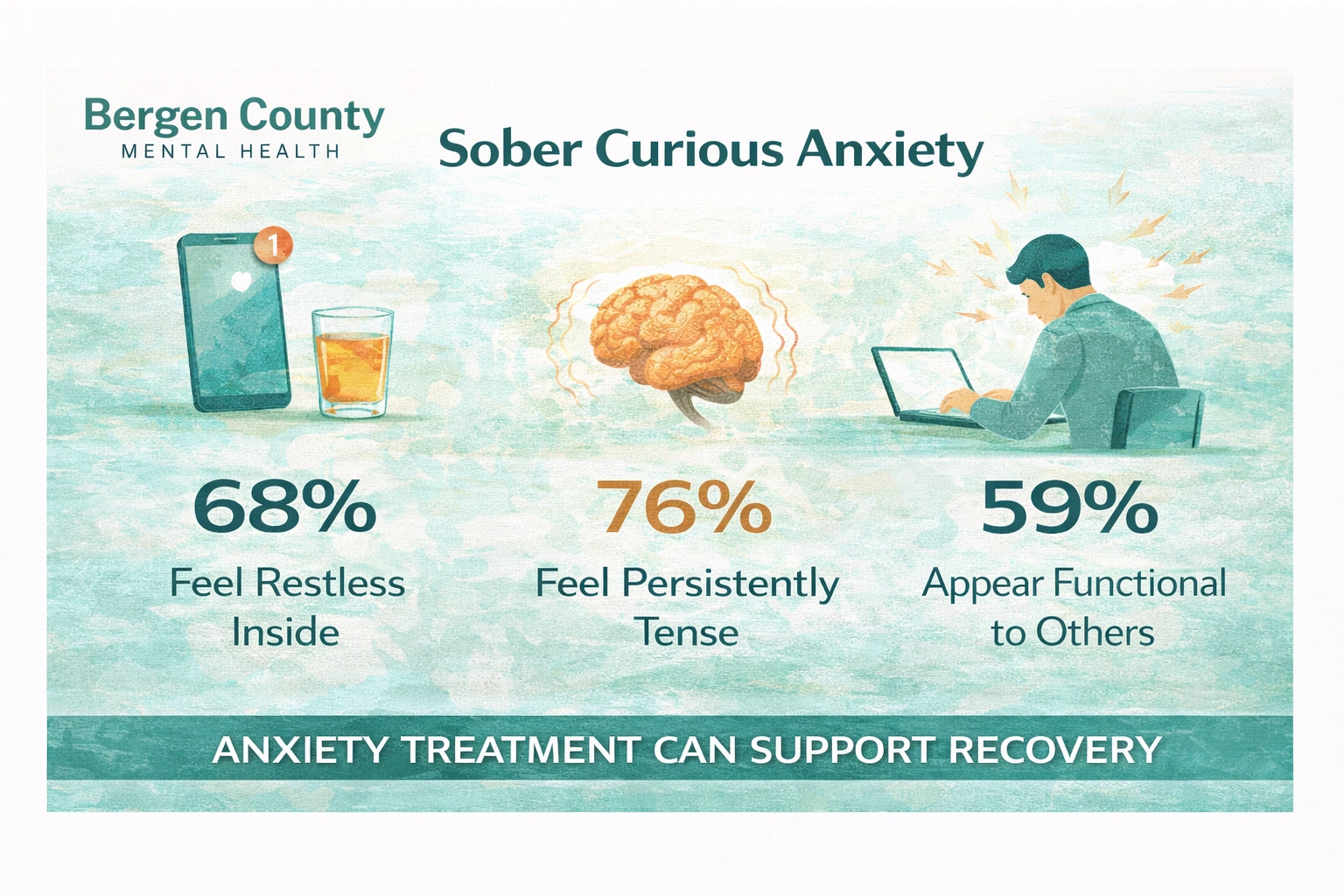
How Anxiety and Alcohol Interact in the Sober Curious Experience
If you’re sober curious — or exploring what life without alcohol looks like — chances are your nervous system is coming into sharper focus.
Alcohol numbs the nervous system. It quiets inner chatter. It softens edges.
When you stop relying on that chemical blanket, all the noise you were avoiding starts to feel louder.
And that can feel like anxiety — because it is anxiety. Your system is waking up.
Anxiety treatment helps you differentiate between:
- Emotional discomfort you used to numb
- Fear that used to hide under liquor
- Bodily sensations that have always been there
- Patterns your mind learned to avoid
No judgment — just clarity.
Once you see the difference between felt experience and fear response, you stop reacting to every internal signal as if it’s dangerous.
That’s how anxiety treatment helps:
It teaches you what’s real and what’s misinterpreted.
Tools That Make Daily Life Easier
You don’t need to be in crisis to get help. You need tools. Real ones. Skills you can use when the world gets loud, the inside feels heavy, or old habits whisper their invitations.
Anxiety treatment teaches you:
- How to notice tension in your body before panic takes hold
- How to calm your nervous system without avoidance
- How to distinguish signal from noise in your thoughts
- How to engage with emotions instead of turning away
- How to be present — without self‑criticism
These aren’t abstract concepts. They are practical, everyday tools that help you live rather than endure.
Imagine anxiety no longer being the background soundtrack — but something you can turn down to a level where clarity and peace become possible.
That’s what treatment aims to help you learn.
The Nervous System Doesn’t Speak Words — It Signals Sensation
Anxiety is a signal, not a flaw.
Your nervous system communicates through sensations:
- Your heart speeds up
- Your breath gets shallow
- You feel restless or tense
- You get stuck in mental loops
- Sleep becomes elusive
Without understanding that your body is speaking, you might assume something is wrong with you — when in fact your body is trying to communicate.
Anxiety treatment helps you translate those signals so you can:
- Respond instead of reacting
- Recognize patterns before they escalate
- Develop new strategies that don’t involve masking or avoidance
This is learning to live with your nervous system instead of against it.
You Don’t Have to Wait for a Breakdown
Many people delay support until the pain becomes unbearable.
But anxiety treatment doesn’t require a crisis. It’s not “treatment only for the worst days.”
You can start when:
- The quiet moments feel heavy
- You feel worse in stillness than in motion
- You wonder if alcohol is simply a buffer for deeper discomfort
- You feel alone in your experience
- Function feels like survival
This is early support, not last‑resort intervention.
And beginning support early is often more effective than waiting.
What a Session Actually Feels Like
If the idea of therapy feels intimidating or vague, here’s what anxiety treatment actually involves, in clear terms:
- A clinician listens first — without judgment
- You talk about what you’re experiencing
- You notice how your body reacts in real time
- You learn skills that feel usable — not abstract
- You build awareness and self‑connection
No pop psychology.
No pressure to have perfect answers.
No shaming for what you’ve felt or done.
Just real support, grounded in respect for your experience.
You’re Not Avoiding — You’re Protecting
Many people think:
“I should be able to feel this without help.”
“I should just be able to handle it.”
“I’m overthinking this.”
That’s not weakness. That’s protective strategy.
Your brain and body are trying to keep you safe — the best way they know how. Anxiety treatment doesn’t judge that instinct. It helps you rewire it.
It’s like retraining an old map so you don’t keep returning to the same unhelpful routes.
Building a Life With Presence, Not Just Performance
Being functional on the outside is not the same thing as being present on the inside.
Anxiety treatment helps you move from:
- Surviving → Thriving
- Masking → Understanding
- Reacting → Responding
- Fear avoidance → Emotional engagement
This doesn’t happen overnight. It happens with practice, patience, and support.
And it often begins with curiosity — like you have right now.
You’re paying attention to a feeling that’s been persistent. That alone is a meaningful step.
A Memorable Metaphor: Anxiety Is Like Static on a Radio
Imagine tuning a radio.
You find a station, but there’s static — constant, irritating, present.
You could try to ignore the static. You could turn up the volume. You could stop listening altogether.
Or you could tune the dial.
Anxiety treatment helps you tune the dial.
It doesn’t make the signal perfect — but it makes it clearer.
Once the static lessens, you can hear the music underneath.
That’s what happens when you learn how to work with your nervous system instead of against it.
Hope Is a Skill — Not a Hunch
Hope doesn’t come from ignoring pain.
It comes from understanding it.
When you stop trying to bury anxiety under distraction, avoidance, or numbness — and you start learning how your system works — you begin to feel:
- Less overwhelmed
- Less reactive
- Less afraid of your own experience
- More present in your own life
- More capable of connection
And that’s how real change begins.
FAQs: When Anxiety Treatment Fits Your Sober Curious Journey
1. Do I need to be in crisis to benefit from anxiety treatment?
Absolutely not. Anxiety treatment helps people who are functional but tired, curious about sobriety, and interested in understanding their internal experience — not just those in acute crisis.
2. Will therapy make me focus only on my emotions?
Treatment is tailored to you. You won’t be forced to dive into anything you’re not ready for. The focus is on practical tools you can use in daily life, step by step.
3. Is this helpful even if I’m not sure if I have anxiety?
Yes. Many people come in unsure if what they’re feeling counts as anxiety. Treatment starts with understanding your experience — not labeling it.
4. Can anxiety treatment help me even if I still drink sometimes?
Yes. You don’t have to be fully sober to benefit. Many people explore anxiety treatment as part of becoming sober curious — it helps separate internal signals from learned coping patterns.
5. How soon can I notice changes?
Some people notice small shifts in awareness or regulation early in treatment. Deeper, sustainable change grows with consistent practice and reflection. The key is engagement, not perfection.
Support That Meets You Where You Are
You don’t have to have everything figured out.
You don’t have to be at your worst.
You don’t have to wait for a complete breakdown to deserve support.
If you’re tired of feeling like you’re performing well on the outside but exhausted on the inside, that’s enough reason to take the next step.
Call (201) 389-9208 to learn more about our Anxiety Treatment services in New Jersey.
You don’t have to walk this alone.
You just have to start the conversation.