


You might’ve told yourself you just needed to “get it together.”
A few therapy sessions. Better sleep. Less spiraling. Maybe a few days off work and a promise to finally slow down.
Then suddenly you’re staring at two treatment options that sound way more serious than you expected — and wondering how things got this heavy in the first place.
For a lot of high-functioning adults, this is the moment things become real. Not dramatic. Just undeniable. And understanding the difference between structured daytime care and multi-day weekly treatment can make the next step feel a lot less intimidating.
If you’re trying to understand what level of support actually fits your life right now, our mental health IOP services can help you sort through that honestly — without pressure.
Most People Wait Longer Than They Needed To
The people who struggle the longest are often the people who look the most “fine.”
They’re still answering emails. Still parenting. Still showing up. Still functioning well enough that nobody realizes how much energy it takes to hold everything together.
That’s why higher levels of care can feel emotionally confusing at first.
A lot of adults assume intensive treatment only exists for people in complete crisis. But many people entering structured mental health care are still working, still paying bills, still smiling in meetings while quietly falling apart inside.
Exhaustion hides well in high achievers.
The Difference Usually Comes Down to Stability
This is where the conversation shifts from labels to reality.
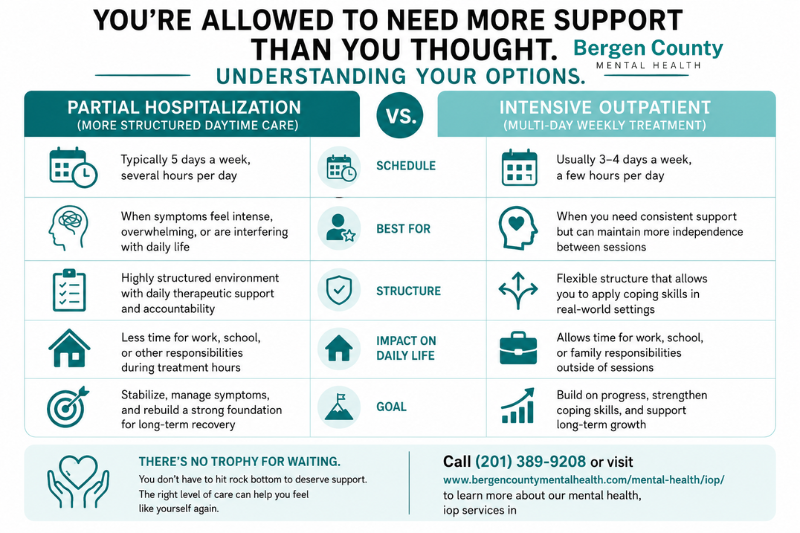
Some people need several hours of support during the day because symptoms are interfering with basic functioning. Others still need meaningful support, but they can safely manage more independence between sessions.
That’s the real distinction.
A more structured daytime schedule tends to help adults who are:
- Barely holding routines together
- Experiencing intense anxiety, depression, or emotional instability
- Struggling to function consistently at work or home
- Needing daily therapeutic accountability
- Feeling emotionally unsafe being alone all day
A multi-day weekly schedule may fit better if someone:
- Needs consistent support but not all-day care
- Can maintain some work or home responsibilities
- Wants treatment without completely stepping away from life
- Is stable enough to practice coping skills between sessions
The phrase php vs intensive outpatient gets searched constantly because people are trying to answer one uncomfortable question:
“How bad does this have to get before I’m allowed to ask for more help?”
The answer is: probably less bad than you think.
High-Functioning Adults Often Minimize Their Own Pain
One of the hardest things about being high-functioning is that people praise you while you’re deteriorating.
You become “reliable.” “Driven.” “Strong.”
Meanwhile your nervous system is running a marathon every single day.
Some adults entering treatment haven’t cried in years because they’ve been emotionally surviving through productivity. Others feel completely numb. Some are drinking more at night just to quiet their brain enough to sleep. Others are mentally checking out while still technically succeeding on paper.
And because nothing has fully collapsed yet, they convince themselves they don’t deserve support.
But functioning is not the same thing as being okay.
That’s an important line.
Treatment Isn’t About Punishment
A lot of adults hear “higher level of care” and immediately picture losing freedom.
That fear makes sense. Especially for people who are used to being the responsible one.
But good treatment should feel less like punishment and more like finally putting weight down.
Not forever. Just long enough to breathe again.
Sometimes people enter more structured care because they truly need stabilization. Sometimes they realize they can recover well in a less intensive setting with strong therapeutic support several days a week.
Neither option means you failed.
It just means your brain and body stopped responding to survival mode.
There’s No Trophy for Waiting Until You Completely Break
This part matters.
Many adults delay treatment because someone else “has it worse.” They compare themselves out of getting help.
But emotional suffering doesn’t need to become catastrophic before it deserves attention.
You do not have to earn support by collapsing first.
And honestly, the people who wait until absolute burnout often need longer recovery because they ignored the warning signs for so long.
A lot of people searching php vs intensive outpatient are not trying to figure out whether they’re “sick enough.”
They’re trying to figure out whether life can feel manageable again.
That’s a different question entirely.
The Right Level of Care Should Help You Feel Human Again
The goal is not to make you dependent on treatment.
The goal is to help you reconnect with yourself underneath the exhaustion, anxiety, shutdown, pressure, or emotional noise you’ve been carrying for too long.
For some people, that starts with more structure.
For others, flexibility with strong support works better.
What matters most is honesty. Not appearances.
And if you’ve spent months convincing yourself you’re “fine” while quietly unraveling, you’re probably more exhausted than anyone around you realizes.
You deserve support before things completely fall apart.
If you’re exploring treatment options in Reclaim Your Mental Health Journey or looking for additional mental health support in New Jersey, Bergen County Mental Health can help you understand what level of care makes sense for your situation.
Call (201) 389-9208 or visit our mental health IOP services to learn more.