


The call you hoped wouldn’t come. The look in their eyes you recognize. The small signals that something isn’t right again.
For many parents, relapse doesn’t appear out of nowhere. It often grows quietly out of stress, fear, and overwhelming emotion. Understanding that connection can bring something many families desperately need: perspective and hope. If your child is struggling, exploring compassionate support for anxiety can be an important step toward stability.
Stress Often Shows Up Before the Substance
Parents are incredibly perceptive. Many describe noticing subtle changes before a relapse happens.
Maybe your child seems constantly on edge.
Maybe sleep becomes irregular again.
Maybe they start withdrawing or reacting strongly to small problems.
Stress doesn’t just sit quietly in the body. It pushes people toward whatever once helped them escape it.
For someone who has used substances in the past, their brain remembers that temporary relief.
Not because they’re weak. Because they’re human.
Anxiety Can Make the Brain Look for Immediate Relief
Imagine anxiety as a smoke alarm that never stops beeping.
Every worry feels urgent. Every emotion feels amplified. The brain starts searching for something—anything—that will quiet the noise.
Substances can temporarily dull that alarm. For a moment, everything slows down.
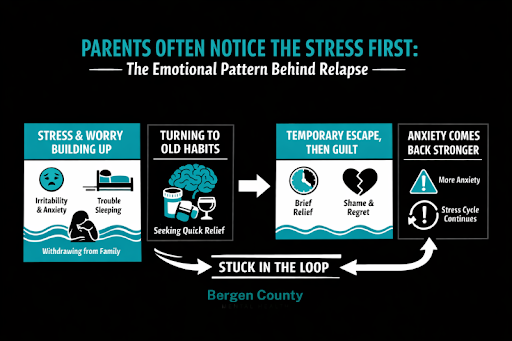
But the relief is short-lived. The anxiety returns, often stronger than before, which can create a painful cycle: stress → relief → shame → more stress.
Parents often blame themselves at this point.
But relapse rarely happens because of one mistake or one conversation. It usually happens because emotional pain didn’t have a safer outlet.
The Hidden Loop Between Anxiety and Relapse
Clinically, we see a pattern again and again.
Unmanaged anxiety increases emotional pressure.
Substance use temporarily lowers that pressure.
The consequences raise anxiety even higher.
It becomes a loop.
Breaking that loop requires more than willpower. It requires helping someone develop new ways to regulate stress, process fear, and feel safe in their own mind again.
That’s where treatment that addresses both emotional distress and substance use together becomes so important.
Therapy Helps Rewire How the Brain Responds to Stress
The goal of therapy isn’t simply to stop a behavior.
It’s to teach the brain a different response to overwhelming emotion.
Evidence-based approaches can help people:
- Recognize early anxiety signals before they escalate
- Develop tools to calm the nervous system
- Challenge catastrophic thinking patterns
- Rebuild confidence after relapse
- Create healthier coping strategies that actually last
Over time, the brain learns that relief doesn’t have to come from substances anymore.
Relief can come from understanding what’s happening internally—and knowing how to respond.
Parents Are Often Carrying More Than They Realize
One thing many parents quietly admit in therapy is this:
They’re exhausted.
You’ve likely spent years worrying, researching, hoping, and trying to help. It’s natural to wonder if you missed something or should have done more.
But love is not the cause of relapse.
In fact, the consistent care parents provide is often one of the strongest protective factors in recovery.
Sometimes the most powerful shift isn’t doing more—it’s bringing in additional support so you don’t have to carry this alone.
Families across the state often start by exploring treatment options in New Jersey that address both emotional health and substance challenges at the same time.
Healing Often Starts With Calming the Storm Inside
Relapse can feel like everything has fallen apart again.
But many clinicians see something different.
Often, relapse is a signal that deeper emotional pain still needs attention. It’s not the end of recovery—it’s information.
When anxiety, stress, and substance use are treated together, people frequently begin to experience something they haven’t felt in a long time:
Internal quiet.
And from that quiet place, change becomes much more possible.
If your family is navigating this difficult moment, you’re not alone. Call 201-389-9208 or explore our therapies, anxiety services to learn how compassionate care can support your child and your family.