


If you’ve ever found yourself crying over a misplaced set of keys, snapping at someone you love because they asked a simple question, or feeling completely overwhelmed by a minor inconvenience, you’re not alone.
Many people come into therapy asking some version of the same question: Why do my emotions go from zero to one hundred over such small things? The answer is usually more complicated—and more hopeful—than they expect.
Within the first steps of learning healthier emotional skills, many people discover that these reactions aren’t signs of weakness or failure. They’re often signals that something deeper is happening beneath the surface. That’s one reason therapies like Dialectical Behavior Therapy (DBT) can be so effective for people who feel emotionally overwhelmed.
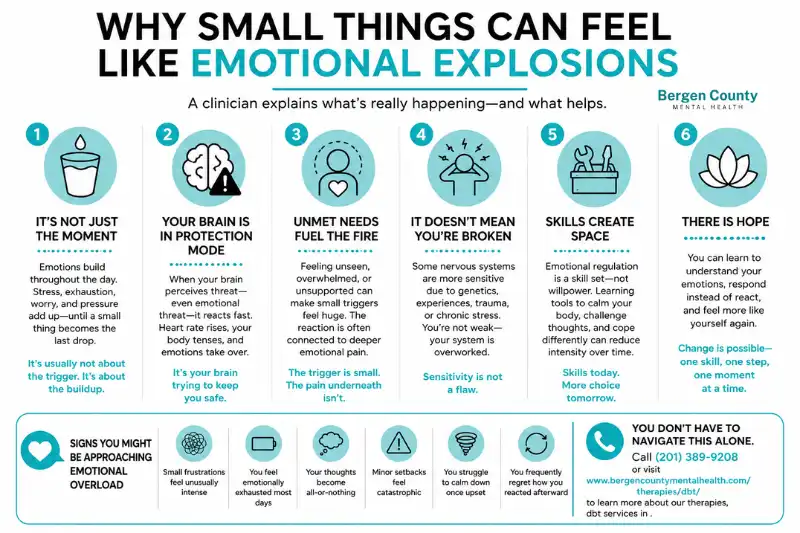
Your Reaction Isn’t Just About the Moment
One of the biggest misconceptions about intense emotions is that they’re caused entirely by whatever just happened.
In reality, emotional reactions are often cumulative.
Think of your emotional system like a cup filling with water throughout the day. Stress from work. Lack of sleep. Family conflict. Financial pressure. Worry about someone you love. Disappointment you haven’t processed yet.
By the time your child forgets to call you back or your coffee spills on the kitchen counter, the cup may already be overflowing.
The spill wasn’t the problem. It was simply the last drop.
As a clinician, I often remind people that emotional intensity is rarely about the size of the trigger. It’s about the amount of strain the nervous system is already carrying.
Your Brain May Be Operating in Survival Mode
When emotions escalate quickly, your brain isn’t always responding from a place of careful reasoning.
Instead, it may be responding from a place of protection.
The brain is designed to detect threats. Sometimes those threats are obvious. Other times they’re emotional.
A delayed text can feel like rejection.
Constructive feedback can feel like failure.
A disagreement can feel like abandonment.
When the brain interprets a situation as threatening, it activates survival responses. Heart rate increases. Thoughts speed up. Emotional intensity rises.
This process happens incredibly fast.
For someone already carrying stress, anxiety, trauma, or chronic emotional exhaustion, the emotional alarm system may become extra sensitive—like a smoke detector that goes off every time someone makes toast.
The Hidden Role of Unmet Emotional Needs
Sometimes strong reactions are connected to needs that haven’t been acknowledged.
For example:
- Feeling unseen
- Feeling unsupported
- Feeling exhausted
- Feeling disconnected
- Feeling overwhelmed by responsibilities
Parents often understand this instinctively.
Imagine a parent whose 20-year-old child has started struggling again after a period of stability. They may tell themselves they’re upset about a missed phone call. But beneath that frustration may be fear, grief, helplessness, and months of emotional exhaustion.
The missed call becomes the surface-level trigger. The deeper emotions are what create the intensity.
This doesn’t mean your feelings are irrational.
It means they’re carrying more weight than the moment itself reveals.
Emotional Intensity Doesn’t Mean You’re Broken
Many people feel ashamed after an emotional outburst.
They replay the conversation.
They criticize themselves.
They wonder why everyone else seems able to stay calm.
What they often don’t realize is that emotional sensitivity exists on a spectrum. Some nervous systems simply register experiences more intensely.
Research and clinical experience both show that factors such as genetics, life experiences, chronic stress, trauma, and environmental pressures can all influence emotional reactivity.
The goal isn’t to eliminate emotions.
The goal is learning how to experience them without feeling controlled by them.
That’s a very different objective—and a much more achievable one.
What Actually Helps Slow the Escalation
Many people assume they need more willpower.
Usually, they need more skills.
This is where emotional regulation help becomes valuable. Learning to regulate emotions isn’t about suppressing them. It’s about recognizing what’s happening early enough to respond intentionally.
Quick Signs You’re Approaching Emotional Overload
- Small frustrations feel unusually intense
- You feel emotionally exhausted most days
- Your thoughts become all-or-nothing
- Minor setbacks feel catastrophic
- You struggle to calm down once upset
- You frequently regret how you reacted afterward
The earlier you notice these signals, the more options you have.
Therapeutic approaches such as DBT teach practical skills for identifying emotional patterns, calming the nervous system, tolerating distress, and responding more effectively during difficult moments.
For some people, additional levels of support may be helpful, including structured outpatient services and specialized mental health programs. Accessing care in New Jersey or finding ongoing support in New Jersey can provide additional tools and guidance when emotions feel difficult to manage alone.
A Different Way to Think About Emotional Reactions
When emotions go from zero to one hundred, it can feel frightening.
But in many cases, your emotions aren’t malfunctioning.
They’re communicating.
They’re telling you that your nervous system is overwhelmed, that stress has accumulated, that old wounds may still need attention, or that important needs aren’t being met.
The question often isn’t, “What’s wrong with me?”
The more useful question is, “What is this reaction trying to tell me?”
That shift alone can reduce shame and open the door to meaningful change.
You don’t have to keep feeling trapped in a cycle of emotional explosions followed by guilt. With the right support and skills, emotional reactions can become easier to understand and manage.
Call (201) 389-9208 or visit our DBT therapy services to learn more about our therapies, dbt services in .