


I kept telling myself I was just tired. Busy. Burned out. Maybe even ungrateful.
But deep down, I knew something felt off.
I could still get through the day. I answered texts. Went to work. Smiled when I needed to. But everything felt muted, like I was watching my own life through thick glass. That’s what eventually pushed me to look into depression therapy options in Bergen County.
Not because I completely fell apart.
Because I slowly disappeared from myself.
I Didn’t Feel “Sad.” I Felt Gone.
That was the confusing part.
I wasn’t crying all the time. I wasn’t stuck in bed. I just stopped feeling connected to anything. Music sounded flat. Conversations felt draining. Even things I used to care about started feeling like obligations.
People around me assumed I was doing okay because I was still functioning.
But functioning and feeling alive are not the same thing.
A lot of people searching for a therapist for sadness Bergen County aren’t looking for someone to fix a dramatic crisis. Sometimes they’re just trying to understand why everything suddenly feels so heavy.
The Exhaustion Was More Than Physical
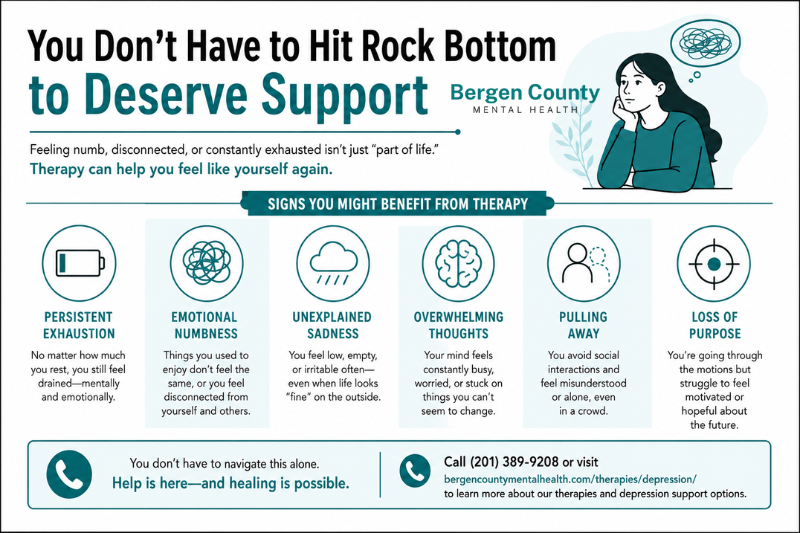
I kept sleeping, but never felt rested.
Simple things started taking too much energy. Replying to emails. Making plans. Grocery shopping. It felt like my brain was carrying invisible weight all day long.
The weirdest part? I couldn’t explain it to anyone without sounding dramatic.
So I minimized it.
That’s what emotional numbness does sometimes. It convinces you your pain “doesn’t count” because it isn’t loud.
But numbness is still pain. It’s just quieter.
I Thought Therapy Was Only for “Serious” Problems
I waited longer than I should have because I thought therapy was for people in crisis.
Meanwhile, I was waking up every day already emotionally exhausted.
I think a lot of us carry this idea that we need a perfectly valid reason to ask for help. Some huge breakdown. Some undeniable rock bottom.
But therapy can also be for the slow erosion of joy.
For the version of you that keeps saying, “I’m fine,” while secretly feeling disconnected from your own life.
That realization changed something for me.
The First Honest Conversation Felt Strange—and Relieving
I remember trying to explain how I felt during my first session. I kept apologizing because my problems didn’t sound “bad enough.”
The therapist stopped me and said something simple:
“You don’t have to earn support by suffering more.”
That line stayed with me.
I wasn’t looking for someone to magically fix me. I just needed space to say out loud that I was tired of carrying everything internally.
And honestly, hearing my own thoughts spoken out loud helped me realize how long I’d been surviving instead of living.
Healing Didn’t Happen All at Once
Therapy didn’t turn me into a brand-new person overnight.
What changed first was smaller than that.
I started noticing moments again.
Laughing without forcing it. Feeling present during conversations. Having enough emotional energy to care about things again.
It felt less like becoming someone new and more like slowly returning to myself.
Like finding color after months of gray.
There were still hard days. There still are sometimes. But I stopped feeling emotionally stranded inside my own life.
That matters.
You Don’t Need to Wait Until Everything Falls Apart
A lot of people delay getting help because they think they should be able to “push through.”
I did that too.
But emotional exhaustion has a way of spreading into everything eventually—your relationships, your motivation, your sense of identity, even your ability to feel hope.
Reaching out for support doesn’t mean you’re weak. Sometimes it means you’re finally listening to yourself.
If you’ve been feeling disconnected for a long time, there’s nothing dramatic or selfish about wanting things to feel lighter again.
Support exists. Real support. The kind that helps you reconnect instead of pretending harder.
You can explore mental health care in New Jersey or learn more about support available through Reclaim Your Mental Health Journey.
Call (201) 389-9208 or visit our depression services to learn more about our therapies and depression support options.