


It’s a hard thing to admit—even to yourself.
You’ve done what you were told to do. Therapy, support, patience. And still, something isn’t getting better.
If you’re quietly wondering whether your child needs more than weekly sessions, you’re not alone. And there are next steps that don’t involve losing them to a hospital setting.
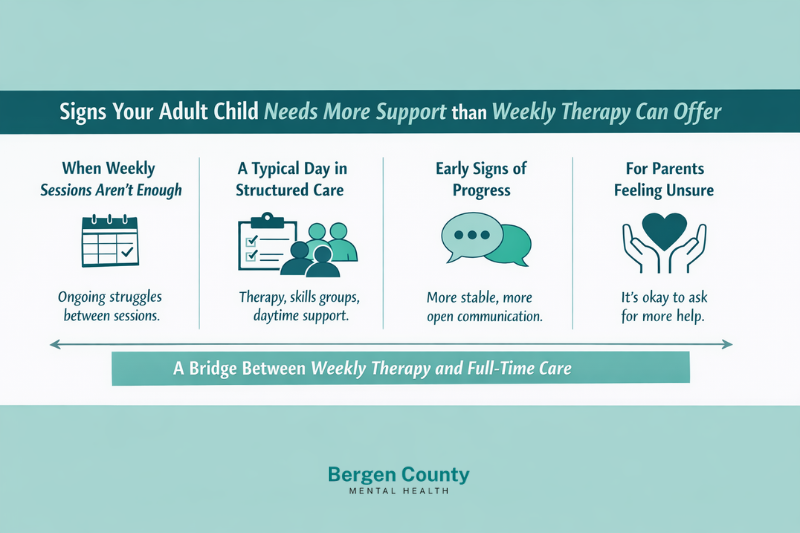
Early on, many families begin exploring more structured care through options like a partial hospitalization program—a level of support that bridges the gap between once-a-week therapy and full-time inpatient care.
Why Weekly Therapy Sometimes Stops Being Enough
Weekly therapy can be powerful—but it has limits.
If your child is struggling day-to-day, one hour a week may not be enough to stabilize what’s happening between sessions. Patterns continue. Crises repeat. Progress feels fragile.
This is often the moment parents start searching things like therapy not enough what next—not because they’ve given up, but because they’re trying to keep going.
Sometimes, that search also begins with trying to find a therapist in Bergen County, only to realize that a higher level of support may be necessary to meet their child’s current needs.
Wanting more support doesn’t mean therapy failed. It means your child may need a different level of care right now.
What a Structured Day of Support Actually Looks Like
A structured daytime program isn’t a locked ward. It’s not cold or isolating.
It’s closer to a school day—but designed for healing.
A typical day might include:
- Morning check-in: Setting goals, grounding emotions, getting oriented
- Group therapy sessions: Learning skills, sharing experiences, feeling less alone
- Individual therapy time: Deeper one-on-one work with a clinician
- Skill-building workshops: Managing anxiety, emotional regulation, communication
- Breaks and meals: Time to reset, reflect, and breathe
- Afternoon processing: Making sense of the day and preparing for the evening
They come home at night. They stay connected to family. But during the day, they’re held in a level of support that weekly therapy simply can’t provide.
What Parents Often Notice (and Feel) at First
Many parents hesitate here—and that hesitation makes sense.
You might be thinking:
- Is this too much?
- Will they feel punished?
- Am I overreacting?
But what we often see is something different.
Parents notice:
- Their child is more stable by the end of the week
- There’s less crisis cycling
- Conversations feel less tense, more honest
- There’s finally a sense of forward movement
And underneath all of that, there’s something quieter: relief.
Not because everything is fixed—but because you’re no longer carrying it alone.
Many adults who feel they need more support but still show up to work describe this same sense of relief when they finally stop managing everything in silence.
A Small Glimpse of What Progress Can Look Like
“I didn’t think anything would change. But after a couple weeks, she started talking again—not just answering questions, but actually talking.”
– Parent of a young adult client
Progress doesn’t usually look dramatic.
It looks like small returns—eye contact, honesty, consistency.
Those moments matter more than they seem.They often reflect the same kind of healing that happens when you need to slow down without disconnecting from your life, relationships, and sense of self.
It’s Not About “More Treatment”—It’s About the Right Support
There’s a difference between more and right.
Structured care works because it meets your child where they actually are—not where we wish they were. It provides repetition, consistency, and real-time support.
Over time, this kind of support can also strengthen family communication, which is why conversations around anxiety treatment and relationships often become an important part of the healing process.
For many families, it becomes the turning point between feeling stuck and finally seeing traction.
If you’ve been searching for treatment options in New Jersey, this level of care is often where things begin to shift—not overnight, but steadily.
You’re Allowed to Ask for More Help
There’s a quiet kind of guilt parents carry in this moment.
I should be able to fix this.
I should have caught it sooner.
But needing more support doesn’t mean you’ve failed.
It means you’re still showing up.
And that matters more than anything.
In some cases, families also find it helpful to understand how anxiety treatment helps newly sober cope with loneliness, especially when emotional isolation is part of what’s making things harder.
If you’re looking for thoughtful, structured help in New Jersey, there are options designed to support both you and your child without taking them out of their life completely.
Call 201 389-9208 or visit our Partial Hospitalization Program services in New Jersey to learn more.