


You sit at the kitchen table again, watching the clock, thinking about the last text you got. It was short. Abrupt. Defensive. You replay it in your head, again and again, trying to figure out what it really means. You love your child — deeply — but right now you feel like you’re watching two forces tugging at them: anxiety and addiction. And you don’t know which is winning.
Is this fear talking?
Or is this use talking?
Are they trying to tell you something — or just avoid something?
These questions aren’t small. And there isn’t always a clear line between anxiety and addiction, especially when they show up in the same body, the same voice, the same set of choices. But there are patterns beneath the surface, and there are ways to understand what’s driving the behavior.
Anxiety treatment can help you see those patterns more clearly — not as a label, but as a map. At Bergen County Mental Health, we help families decode the signals beneath the behavior, reduce confusion, and decide what kind of help is actually needed.
This isn’t about assigning blame. It’s about understanding.
Why Anxiety and Addiction Often Look Alike
When your child was impulsive, avoidant, irritable, or unpredictable, you probably asked yourself:
- Is this anxiety?
- Is this addiction?
- Is this both?
And the honest answer is: yes — it can be both.
Anxiety and addiction often overlap because:
- People with anxiety sometimes use substances to self‑soothe
- Substances can increase anxiety when the effects wear off
- Anxiety can make coping skills feel unreachable
- Addiction can mask underlying fear and worry
So what looks like “just using again” might also be a fear response disguised as substance use. And what feels like anxiety might also be fueled by patterns of avoidance tied to past use.
They’re intertwined. Not always neatly separable. But when you understand the why behind the behavior, you can respond with both clarity and compassion.
What Anxiety Treatment Actually Helps You See
When we talk about anxiety treatment in Bergen County, New Jersey, we’re not talking about generic advice or telling someone to “calm down.” We’re talking about a process that helps both you and your child understand what’s going on beneath the surface.
Anxiety isn’t just a feeling.
It’s a nervous system state, and it shows up in how the body reacts — not just what the mind says.
Anxiety treatment helps:
- Identify triggers that precede emotional shutdown
- Recognize physical signs of fear and panic
- Separate emotional reactions from learned survival habits
- Understand how avoidance becomes a coping mechanism
- Create new ways of responding to stress
These patterns often get buried under addictive behavior because substances act like a quick—but temporary—escape hatch. Anxiety treatment helps your child learn how to open a new door, not just escape through the old one.
A Story of Overlap: When Anxiety Was the Engine
Imagine your child’s behavior as a car. You see the brakes screeching. You hear the tires spinning. You notice the car isn’t moving forward.
Addiction is like having the gas pedal stuck.
Anxiety is like having no clear road in sight.
Sometimes the car is stuck because both are happening at once: the pedal is stuck AND there’s no direction.
Anxiety treatment allows you to:
- Unstick the pedal of emotional reactivity
- Map the road ahead instead of just reacting to the brakes
- Notice which systems are driving behavior — instinct or habit
- Teach the driver new tools to steer and regulate
This metaphor helps parents see that “why” matters as much as “what.”
How Anxiety Often Feeds Into Use
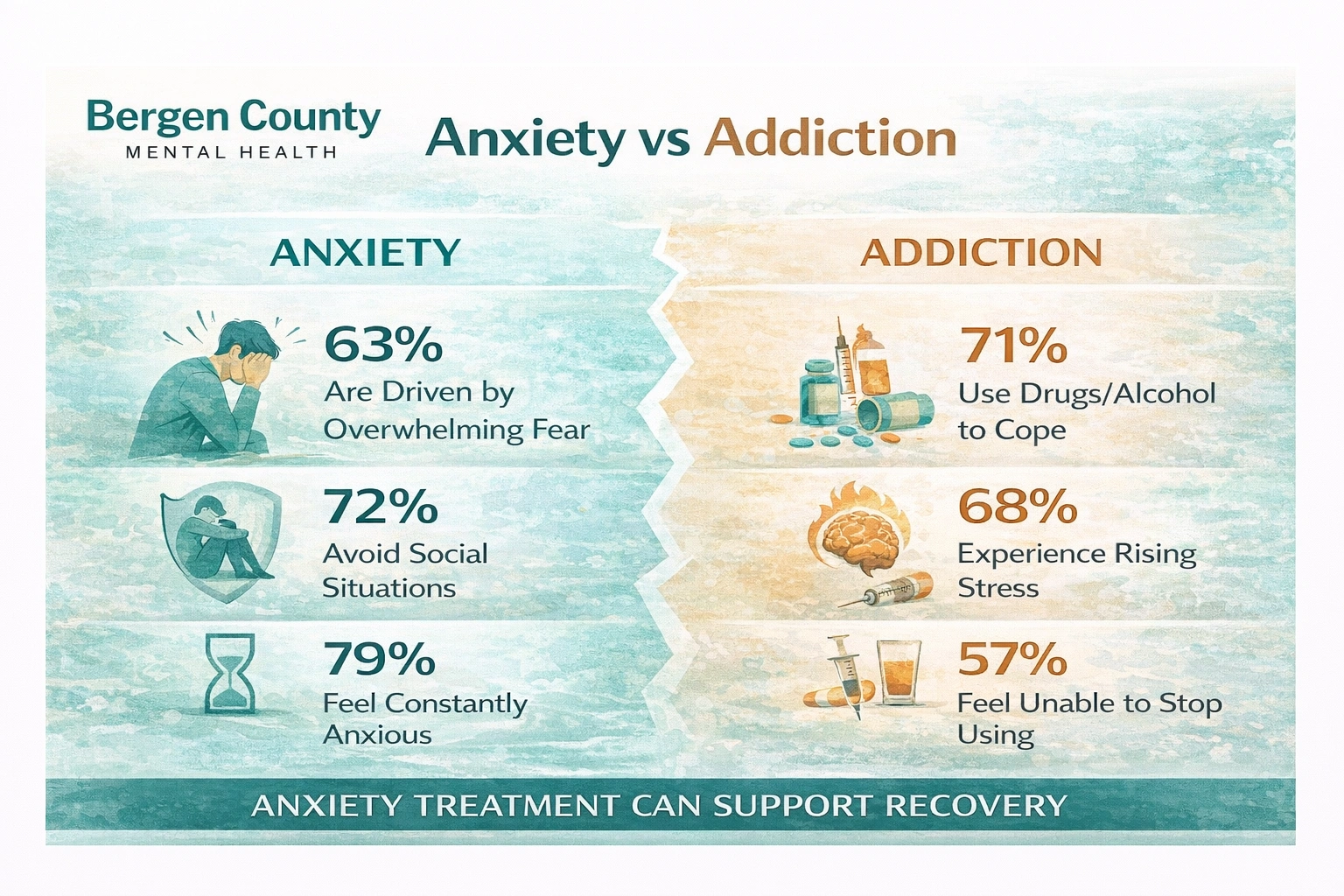
One of the reasons anxiety and addiction can look so similar is because anxiety often precedes use.
Your child might use substances because:
- They feel overwhelmed by stress
- They can’t regulate emotional intensity
- Social situations feel unbearable
- They’re trying to quiet internal chaos
- They fear rejection or judgment
In these cases, substance use feels like relief — because it distracts from the internal alarm system.
But the relief is temporary. And when it wears off, the anxiety comes back louder.
Anxiety treatment helps your child build real tools for regulation so they don’t have to lean on substances as the only way to cope.
When Anxiety Is Mistaken for “Bad Behavior”
Many parents interpret anxiety‑driven behavior as:
- Defiance
- Manipulation
- Laziness
- Drama
- Immaturity
It’s natural to do this. That’s how humans interpret unexplained behavior. But if the root is fear — not intention — the meaning shifts dramatically.
Anxiety treatment teaches you to look for:
- What happened before the behavior
- What emotions were present
- What situations cause withdrawal or escalation
- What patterns repeat over time
Once you begin to see these elements, behavior stops feeling like intentional resistance and starts feeling like a signal that needs decoding.
Anxiety Treatment Helps You Tune Into the Nervous System
Your child’s body may be reacting long before their mind has words for it.
Signs include:
- Heart racing without a clear trigger
- Muscle tension that doesn’t go away
- Sleeplessness or interrupted sleep
- Constant scanning of the environment
- Avoidance of once‑normal social situations
These are not “bad behaviors.” They are survival responses.
Anxiety treatment doesn’t tell them to “just relax.” It helps them understand the mechanics of fear — how the body prepares for threat, even when the threat isn’t real.
This gives your child insight into their reactions instead of confusion about them.
When Addiction Complicates Anxiety — and Vice Versa
In many cases, anxiety and addiction don’t act alone.
Anxiety can lead to use.
Use can increase anxiety.
Anxiety can deepen isolation.
Isolation can increase use.
It becomes a feedback loop — each factor amplifies the other.
Treatment that only focuses on one side (use or anxiety alone) often leaves the other part intact — and relapse risk remains high.
Anxiety treatment helps break the cycle by teaching skills that make both external stressors and internal fear more manageable.
What Parents Often Misinterpret as “Resistance”
When your young adult pushes back at offers of help, ignores your concerns, or seems defensive, it’s easy to take it personally.
But resistance is often a fear response.
It can look like:
- Irritation at gentle questions
- Dismissing help before trying it
- Minimizing what they’re feeling
- Avoiding conversations that feel too close
- Saying “I’m fine” when they’re clearly not
These aren’t signs of stubbornness.
They’re signs of vulnerability — fear of exposure, fear of judgment, fear of loss.
Anxiety treatment helps your child name that fear so it no longer has to be their default response.
Supporting Your Child Without Enabling
Parents often ask:
How do I support them without enabling the very patterns I want to help them change?
This is where clarity matters.
Once you can see the difference between:
- Anxiety‑driven avoidance
- Addiction‑driven coping
- Habitual patterns
- Fear responses
You can support with both:
- Boundaries (which create safety)
- Empathy (which builds connection)
- Structure (which creates predictability)
- Skills (which build resilience)
Your support becomes effective instead of reactive.
Anxiety treatment often includes parent guidance — not to place blame, but to help you understand what’s happening beneath the behavior.
When to Consider Anxiety Treatment
You don’t need to wait for a crisis to seek clarity.
Consider anxiety treatment when you notice:
- Persistent avoidance of normal life activities
- Emotional responses that seem disproportionate
- Use that seems tied to stress or fear
- Withdrawal from supportive relationships
- Physical signs of chronic stress
These patterns don’t fade on their own. They persist because your child hasn’t been given the skills to regulate internal experience.
Anxiety treatment doesn’t tell someone to “just calm down.”
It teaches them how.
Healing Happens When Fear Is Understood — Not Ignored
Your instinct as a parent is to protect, fix, or rescue. That’s love. But fear doesn’t vanish when you point at it.
Fear softens when it’s understood.
Anxiety treatment gives your child — and you — a map:
- What feels unsafe
- Why it feels unsafe
- How the body responds
- How to regulate responses
- How to build confidence through experience
That’s not theory. That’s real‑world support.
And it’s often the missing piece between anxiety and addiction recovery.
You Don’t Have to Do This Alone
If you’re reading this with a heavy heart, it’s because you care. And care is the beginning of healing.
You don’t have to decode this on your own. You don’t have to guess what’s driving the behavior. You don’t have to place blame on your child or yourself.
Call (201) 389-9208 to learn more about our Anxiety Treatment services in New Jersey.
Understanding is the first step toward healing — for your young adult, for you, and for your family as a whole.
FAQs: Anxiety and Addiction — What Parents Want to Know
1. How can I tell if it’s anxiety or addiction driving the behavior?
Behavior alone rarely gives a full answer. Anxiety tends to show as avoidance, hypervigilance, panic responses, or emotional withdrawal. Addiction often shows as compulsive use, tolerance escalation, and prioritizing use over needs. The two can overlap, which is why clinical assessment through anxiety treatment is so helpful.
2. Can anxiety cause someone to use substances again?
Yes. Many people use substances as an attempt to regulate overwhelming emotions or internal fear. Anxiety can be a driver of use — especially if the person hasn’t developed alternative coping skills.
3. Will anxiety treatment replace addiction treatment?
Not necessarily. Anxiety treatment complements addiction recovery by addressing the emotional and nervous system patterns that fuel avoidance and use. Often both are needed for long‑term stability.
4. How long does anxiety treatment take before we see changes?
Some people notice small improvements early in treatment — especially in awareness and regulation skills. Deeper shifts take consistent engagement, often over weeks or months. The goal is sustainable change, not overnight fixes.
5. Can family members be involved in anxiety treatment?
Yes. Many programs include family guidance, education, and support so parents understand the dynamics of anxiety and how to support rather than unintentionally reinforce avoidance or fear‑based responses.