


You might not have meant to stop going. Or maybe you did—and it felt like the only option at the time. Either way, stepping away from care doesn’t mean you failed. It just means something didn’t fit.
If you’ve been thinking about trying again, especially something flexible like an Intensive Outpatient Program, there are ways to make it feel different this time—more human, more workable, more yours.
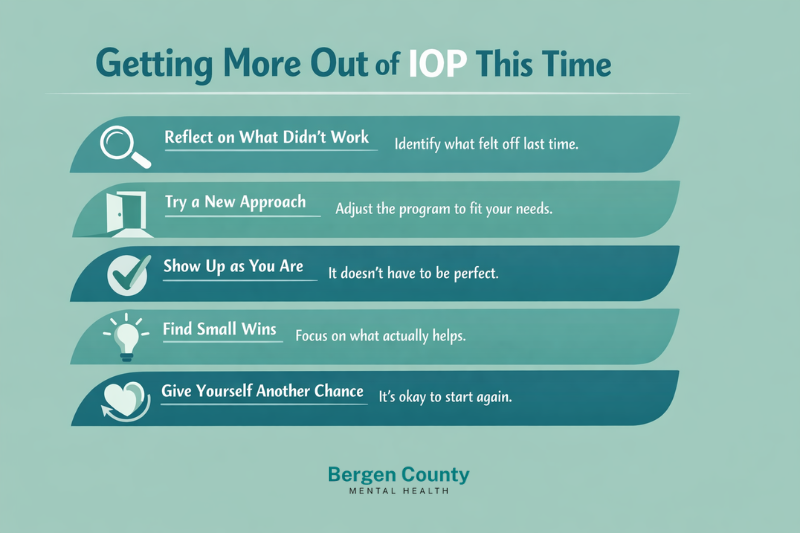
Start With What Didn’t Work (Without Judging It)
Before anything else, take a breath and look back—gently.
Was it the schedule?
The group dynamic?
The emotional intensity?
Or did life just get in the way?
There’s no gold star for pushing through something that isn’t landing. Knowing what didn’t click is actually useful. It helps you ask better questions and advocate for what you need now.
Sometimes the shift isn’t dramatic. It’s as simple as saying, “I need this to feel manageable if I’m going to stay.”
Let It Be Different This Time
One quiet truth: treatment isn’t one-size-fits-all.
The version you tried before isn’t the only version that exists.
Some people do better in smaller groups.
Others need more structure—or less.
And for many, a flexible evening mental health program makes it possible to show up without sacrificing work or family responsibilities.
You’re allowed to adjust the approach until it fits your real life—not the other way around.
Focus on Showing Up, Not Doing It Perfectly
A lot of people leave because they feel like they’re “not doing it right.”
They don’t share enough.
Or they share too much and feel exposed.
Or they compare themselves to everyone else in the room.
But this isn’t a performance.
Showing up tired still counts.
Sitting quietly still counts.
Even thinking, “I don’t know if this is helping yet,” still counts.
Consistency matters more than intensity.
Find One Thing That Feels Useful
You don’t have to love every part of the process.
Instead, look for one thing that feels even slightly helpful:
- A coping tool that works on a hard day
- A moment where you feel understood
- A thought that lingers after you leave
That’s enough to build on.
Growth in this space is rarely loud or obvious. It’s often subtle—like realizing you paused before reacting, or that your thoughts feel a little less overwhelming than they did last week.
Give Yourself Permission to Re-Enter
A lot of people hesitate to come back because of one thought:
“They probably won’t want me back.”
That thought keeps more people away than anything else.
But stepping away happens. Life gets messy. Emotions get heavy. Avoidance creeps in.
Coming back isn’t something you have to earn—it’s something you’re allowed to do.
And often, the second attempt feels different simply because you’re walking in with more awareness.
Build Support Around the Program
Treatment works best when it’s not the only support in your life.
That might look like:
- Talking to one trusted person outside of sessions
- Creating small routines that ground you
- Exploring additional treatment options in New Jersey that complement what you’re doing
You don’t have to carry everything inside those few weekly hours.
Support can be layered. And it should be.
You Don’t Have to Start Over—Just Start Again
There’s a difference.
Starting over can feel like erasing everything.
Starting again means you bring what you’ve already learned—even if it didn’t feel like much at the time.
That version of you who tried before?
They still count.
And they probably knew something needed to change. That’s why you’re here now.
If you’re ready to explore support in a way that actually fits your life, you can start by looking into options that meet you where you are—including flexible care through an evening mental health program.
Call (201) 389-9208 or visit the program page to learn more about our Intensive Outpatient Program services in New Jersey.