


I remember thinking, “Okay… I did it. I’m better now.”
And then, a few weeks later, something small cracked the surface—and the anxiety was back.
Not loud. Not dramatic. Just… there.
If that’s where you are, you’re not broken. You’re in the part no one really prepares you for.
The Space Between Structure and Real Life
Inside treatment, things make sense.
There’s a rhythm. People who get it. Tools that feel reachable. You’re practicing in a place built to support you.
Then life resumes.
Work emails. Family dynamics. Silence at night. Decisions that don’t come with a group check-in or a therapist sitting across from you.
That gap?
That’s where anxiety tends to sneak back in.
And it doesn’t mean the work didn’t stick.
You Didn’t Lose Your Progress—You Lost Your Container
This part is hard to admit.
It can feel like everything you learned just… disappeared.
But it didn’t.
What changed is the environment.
Think of it like learning to swim in a calm pool, then being dropped into open water. You still know how to swim—but the waves feel different.
That doesn’t erase your ability.
It just means you need time—and support—to adjust.
The Triggers Are Subtler Now
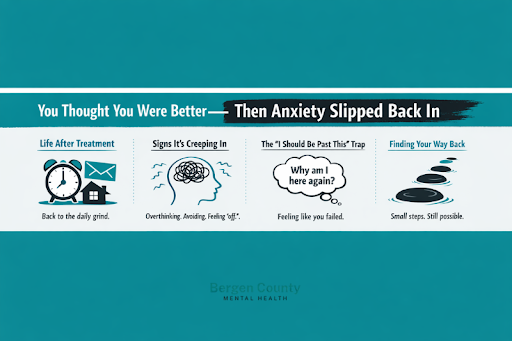
Before, anxiety might’ve been obvious.
Now it’s quieter. Sneakier.
It shows up as:
- Overthinking texts that didn’t used to matter
- Avoiding small decisions
- That low hum in your chest you can’t quite name
- Feeling “off” without a clear reason
And because it’s not as intense as before, it’s easy to dismiss.
But ignoring it is usually where it grows.
“I Should Be Past This” Is the Thought That Hurts the Most
This one hits deep.
You did the work. You showed up. You made changes.
So when anxiety comes back, the first thought is often:
“Why am I back here?”
That thought carries more weight than the anxiety itself.
Because it turns a normal experience into a personal failure.
But this isn’t going backward.
It’s the next layer.
What Helped in Treatment Still Works—It Just Feels Harder to Reach
Let’s be honest.
It’s easier to use coping tools when your day is built around them.
Out here, it takes more intention.
More friction.
More choice.
But those tools? They didn’t stop working.
They just need to be re-practiced in real life.
Sometimes with guidance again.
If you’re feeling that disconnect, revisiting structured support—like therapies for anxiety—can help bridge that gap without starting over.
You’re Allowed to Come Back—Even If It’s Messy
There’s this quiet fear a lot of us carry:
“If I reach out again, what will they think?”
Like we’re supposed to get it right the first time.
But that’s not how this works.
People step back in all the time.
Not because they failed—because they’re paying attention.
Because they caught it early.
Because they don’t want it to get louder.
That’s not weakness. That’s awareness.
Finding Your Way Back to Yourself (Again)
You don’t need to restart your entire journey.
You just need a place to reconnect.
Sometimes that looks like getting support in New Jersey that fits your life now—not where you were months ago.
Different season. Different needs.
Same you underneath it.
A Small Truth to Hold Onto
Anxiety coming back doesn’t erase the version of you that learned how to face it.
That version is still here.
Maybe a little tired. Maybe unsure.
But still capable.
Still worth showing up for.
If this hit close to home, you’re not alone—and you don’t have to figure it out by yourself again.
Call (201) 389-9208 or visit our therapies, anxiety services in to learn more about what support can look like right now.