


You answer texts. You show up to work. You make dinner, pay bills, smile at people in grocery stores. From the outside, your life probably looks functional.
But inside? It feels like your brain is running a marathon in wet cement.
That’s the part people don’t see. And it’s why so many high-functioning adults quietly start searching for things like mental health IOP support at 1am, after another day of barely holding it together.
You Can Be “Doing Well” and Still Be Falling Apart
A lot of people think anxiety and depression have to look dramatic to count.
They don’t.
Sometimes it looks like canceling plans because you can’t fake another conversation. Sometimes it’s lying awake exhausted but unable to shut your mind off. Sometimes it’s succeeding professionally while privately wondering why everything feels so heavy.
High-functioning people are experts at survival. That’s part of the problem.
You become so good at compensating that nobody notices how much pain it takes to maintain the performance.
And eventually, even simple things start feeling emotionally expensive.
The Breaking Point Usually Isn’t Loud
For a lot of adults dealing with anxiety or depression, there isn’t one catastrophic moment. There’s just accumulation.
Weeks of brain fog.
Months of irritability.
Panic attacks that start showing up in parking lots or before meetings.
A constant sense that you’re behind in your own life.
It’s death by a thousand tiny cuts.
One of the hardest truths to admit is this: functioning isn’t the same thing as living well.
You can still be employed, parenting, productive, and deeply unwell at the same time.
Why People Delay Getting More Support
Most people searching for an intensive outpatient program near me aren’t looking because they’ve “given up.”
They’re looking because white-knuckling life stopped working.
Still, people hesitate. Especially high achievers.
They tell themselves:
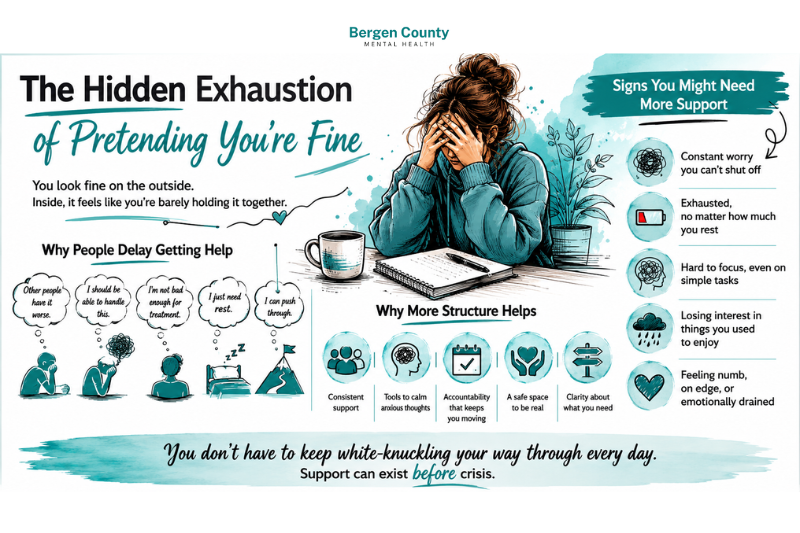
- “Other people have it worse.”
- “I should be able to handle this.”
- “I’m not bad enough for treatment.”
- “I just need rest.”
- “I can push through.”
Maybe you’ve said some version of those too.
But anxiety and depression have a way of shrinking your world slowly. You adapt to the suffering until exhaustion starts feeling normal.
That’s what makes structured support helpful for so many people. Not because they’re broken. Because they’re tired of surviving in silence.
There’s a Difference Between Weekly Therapy and Needing More
Sometimes weekly therapy is enough.
Sometimes it isn’t.
If your symptoms are affecting your work, relationships, sleep, motivation, or ability to function consistently, you may need more support than a once-a-week conversation can provide.
That doesn’t mean you need hospitalization or round-the-clock care.
For many people, multi-day weekly treatment creates a middle ground that feels manageable. More support. More accountability. More consistency. But still enough flexibility to continue living your life outside treatment.
That balance matters for people who are used to carrying responsibilities while struggling privately.
Signs You’re Running on Emotional Fumes
Signs You Might Be Experiencing More Than “Stress”
- You feel emotionally numb more often than calm
- Small tasks suddenly feel overwhelming
- You dread mornings even after sleeping
- You’re isolating without meaning to
- Your patience disappears faster than it used to
- You constantly feel “on edge”
- You keep telling yourself you’ll feel better after the next weekend, vacation, or deadline
At some point, your nervous system stops responding to motivation speeches.
It needs care.
Real care.
The kind that helps you understand why your brain and body feel stuck in survival mode all the time.
Getting Help Doesn’t Mean Your Life Collapsed
A lot of people assume treatment is only for people who completely fell apart.
That belief keeps high-functioning adults suffering way longer than they need to.
The truth is, many people entering structured daytime care still have careers, relationships, responsibilities, and routines. They just finally reached the point where carrying everything alone became unsustainable.
There’s strength in recognizing that before things get worse.
Not after.
And honestly? Relief often starts the moment you stop pretending you’re okay.
Like finally putting down a backpack full of bricks you forgot you were carrying.
If you’ve been looking for help in New Jersey, it may help to know you don’t have to hit some dramatic breaking point before reaching out.
Support can exist before crisis.
You Don’t Have to Keep White-Knuckling Your Way Through Every Day
Living with anxiety and depression can make even ordinary life feel exhausting. If you’ve been quietly carrying more than anyone realizes, there’s nothing weak about needing additional support.
Call (201) 389-9208 or visit our mental health IOP services to learn more about our mental health, iop services.