


Some people reach a point where anxiety stops feeling like “stress” and starts feeling like a full-time job. Sleep gets lighter. Small decisions feel heavy. You cancel plans you wanted to keep. Even answering a text can feel like climbing a hill with wet shoes.
And somewhere in the middle of all that, you start searching for answers.
Maybe that’s how you landed here.
If you’ve been comparing treatment options and wondering which level of support actually fits your life, this guide can help you think through it with less pressure and more clarity. For many people in New Jersey, exploring structured daytime mental health care is the first time things start to feel manageable again.
The Real Question Usually Isn’t “Which Program?”
Most people don’t wake up thinking, I need a certain treatment model.
They think:
- “I can’t keep functioning like this.”
- “Why does everything feel so hard lately?”
- “I’m trying therapy, but I still feel underwater.”
- “I don’t know how much support I actually need.”
That distinction matters.
The goal isn’t picking the “best” program. It’s finding the amount of support that helps your nervous system stop living in constant survival mode.
For some people, a few therapy sessions a week feels stabilizing. For others, anxiety has become so consuming that they need more structure, more clinical contact, and more daily support to interrupt the cycle.
Anxiety Can Look “Fine” From the Outside
One of the hardest things about anxiety is how invisible it can be.
People often wait too long to seek higher levels of care because they’re still technically functioning. They’re going to work. Showing up for family. Smiling in conversations.
Meanwhile, internally, they’re unraveling.
A lot of high-functioning adults in New Jersey quietly live in this exact space. They don’t think they’re “bad enough” for intensive support because they haven’t completely fallen apart.
But anxiety doesn’t have to destroy your life before you deserve help.
Sometimes needing more support simply means your brain and body are exhausted from carrying too much for too long.
More Structure Doesn’t Mean You’ve Failed
This is where many people freeze.
They assume needing daytime treatment means they’ve somehow “lost control” or reached a breaking point.
That’s not what structured care is for.
Think of anxiety like a smoke alarm that never shuts off. Eventually, your nervous system stops knowing what calm feels like. Weekly therapy may help, but it can be difficult to create momentum when you’re spending most of the week dysregulated between sessions.
More immersive support creates repetition. Rhythm. Consistency.
Instead of trying to survive seven days between appointments, you’re building stability day by day.
That’s often the difference people feel most.
The Difference Often Comes Down to Daily Stability
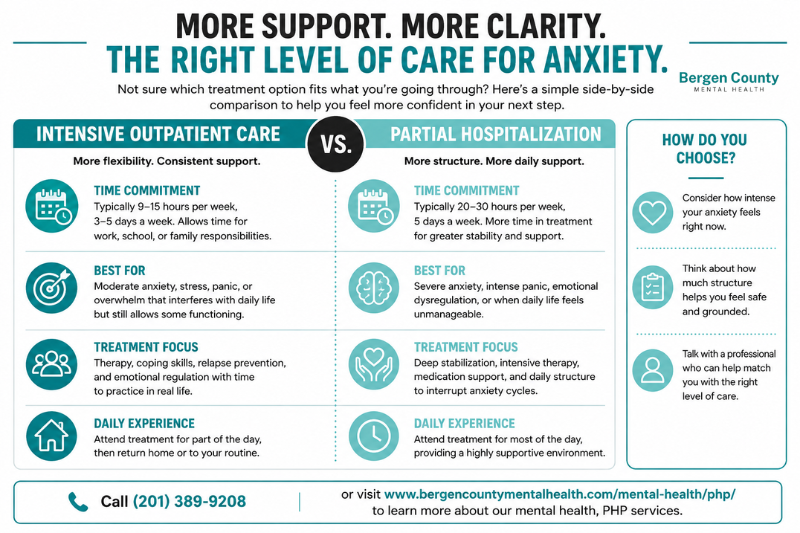
If you’ve been researching iop vs partial hospitalization, you’ve probably noticed the descriptions can blur together.
Both offer therapy. Both provide support. Both are outpatient options.
But emotionally, the experience can feel very different depending on what your anxiety currently looks like.
Multi-day weekly treatment may feel appropriate if:
- You’re still able to work or manage responsibilities part-time
- Anxiety is disruptive but somewhat predictable
- You need support building coping skills and consistency
- Panic, avoidance, or emotional overwhelm happen regularly but not constantly
Structured daytime care may feel more appropriate if:
- Anxiety is affecting basic functioning
- You’re struggling to get through daily routines
- Panic or emotional spirals feel relentless
- You feel emotionally unsafe being alone with your thoughts all day
- Weekly therapy no longer feels like enough support
Neither option is “better.” They simply meet different levels of emotional intensity.
And sometimes people step into one level first, then transition into another as they stabilize.
You Don’t Need to Earn Support by Getting Worse
This might be the most important thing in this article.
A lot of people delay care because they think someone else needs it more.
They minimize their symptoms. Push through exhaustion. Wait for undeniable proof.
But anxiety rarely rewards waiting.
In fact, untreated anxiety often becomes more physically consuming over time. Sleep problems, isolation, irritability, digestive issues, emotional numbness, and burnout can slowly become part of daily life without you even realizing how far things have drifted.
Getting help earlier isn’t dramatic. It’s protective.
There’s strength in recognizing your current coping system isn’t sustainable anymore.
Sometimes the Best Sign Is Relief
Here’s something clinicians notice often:
People exploring higher levels of care sometimes feel embarrassed during the intake call… and then unexpectedly emotional afterward.
Not because they’re weak.
Because someone finally said:
“You don’t have to white-knuckle this alone anymore.”
Relief matters.
If the idea of having more support makes your shoulders drop a little, pay attention to that feeling. Your nervous system may already know what your mind is still debating.
And if you’re looking for compassionate help in New Jersey, it’s okay to ask questions before you feel completely certain.
You Deserve Support That Actually Matches What You’re Carrying
Anxiety can make people believe they should be able to handle everything quietly. But healing usually begins when support finally matches the weight you’ve been carrying alone.
You do not need to hit a dramatic bottom to deserve more care.
Call (201) 389-9208 or visit our mental health PHP services to learn more about treatment options that can help you feel grounded, supported, and emotionally safe again.