


Some people don’t realize how overwhelmed they are until their body starts sounding the alarm at 6:12 every morning.
Your eyes open. Your chest tightens. Your stomach drops before your feet even hit the floor. You tell yourself it’s just stress. Just a rough week. Just work.
But if this keeps happening, your nervous system may be trying to tell you something your mind has been pushing aside for too long.
For many people experiencing structured daytime care, the breaking point didn’t happen in public. It happened quietly. In the dark. Before work. Before coffee. Before anyone else was awake.
Stop Treating Every Morning Like Something to Survive
A lot of people with anxiety still go to work. They answer emails. They make meetings. They smile at coworkers.
That’s part of what makes this kind of struggle so invisible.
You can look “functional” while your nervous system is running a marathon before 8am. Over time, though, your body starts keeping score. Sleep gets lighter. Irritability grows sharper. Small tasks suddenly feel enormous.
The hard part is that many people wait until things completely collapse before asking for help.
You do not have to earn support by falling apart first.
Your Brain May Be Stuck in Threat Mode
Morning panic often has less to do with weakness and more to do with overload.
Sometimes it comes from chronic stress. Sometimes unresolved trauma. Sometimes depression that’s been ignored because it didn’t look dramatic enough. And sometimes it’s the emotional equivalent of carrying too many grocery bags for too long — eventually, your grip gives out.
One of the most common things clinicians hear is:
“I don’t even know why I’m panicking. Nothing bad is happening.”
But your nervous system doesn’t always respond to logic. It responds to pressure, exhaustion, fear, burnout, and emotional suppression.
If you’ve been dealing with morning panic attacks before work, there’s a chance your body has been trying to get your attention for a while now.
The Shame Spiral Makes People Disappear
This is the part people rarely talk about.
Once anxiety starts interfering with daily life, many people begin withdrawing quietly. They cancel therapy appointments. Stop responding to texts. Push through until they can’t. Then they disappear for a while because they feel embarrassed.
That doesn’t mean they don’t want help.
It usually means they’re overwhelmed.
We see this often with people who started treatment before and stopped showing up because life got messy, symptoms got worse, or they convinced themselves they were “fine enough.” The shame afterward can become its own barrier.
But mental health treatment isn’t school attendance. You’re not getting graded.
You’re allowed to come back.
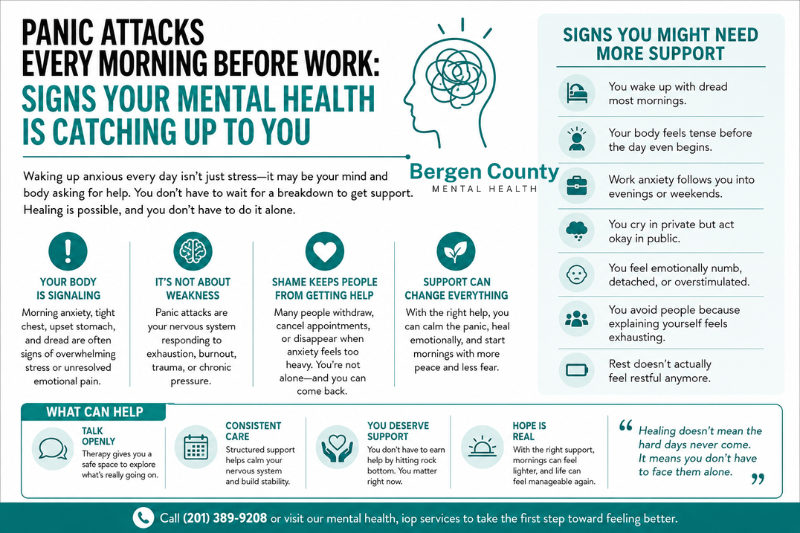
Signs Your Mental Health Might Need More Support
Signs You Might Be Experiencing More Than “Normal Stress”
- You wake up with dread most mornings
- Your body feels tense before the day even begins
- Work anxiety follows you into evenings or weekends
- You cry in private but act okay in public
- You feel emotionally numb, detached, or constantly overstimulated
- You’ve started avoiding people because explaining yourself feels exhausting
- Rest doesn’t actually feel restful anymore
Anxiety can become so familiar that people stop recognizing how much pain they’re actually in.
That doesn’t make it sustainable.
Small Changes Matter More Than Perfect Ones
You do not need to overhaul your life overnight.
Sometimes the first step is simply admitting: This isn’t working anymore.
That might look like:
- Talking honestly with a therapist
- Taking a mental health day without apologizing for it
- Reaching back out after ghosting treatment
- Exploring multi-day weekly treatment that offers more support than one session a week
- Letting someone help carry what you’ve been carrying alone
Healing is rarely dramatic at first. More often, it’s quiet. Consistent. Slightly uncomfortable. Then one morning, you realize your chest isn’t tight anymore before work.
That matters.
You’re Not Lazy, Weak, or Failing
People struggling with anxiety often become experts at self-criticism.
You tell yourself other people handle stress better. That you’re overreacting. That you should just “push through.”
But panic is not laziness. Exhaustion is not weakness. And your body is not betraying you by asking for help.
There’s a reason so many high-functioning people suddenly hit a wall they never saw coming.
The mind can compartmentalize for years.
The body eventually refuses.
If you’ve been searching for answers, support in Reclaim Your Mental Health Journey, or help in New Jersey, you do not have to wait until things become unbearable to reach out.
Call (201) 389-9208 or visit our mental health support program to learn more about our mental health, iop services.