


You go to bed early. You cancel plans to rest. You sleep for eight, nine, maybe even ten hours. And somehow, you still wake up feeling heavy.
For a lot of people, this kind of exhaustion isn’t laziness or weakness. It’s emotional depletion. Sometimes it’s stress. Sometimes it’s depression. Sometimes it’s your mind trying to carry more than it was built to hold alone. If you’ve been feeling empty and tired for a while now, there may be more going on beneath the surface than sleep can fix.
Your Body Might Be Resting While Your Mind Stays “On”
Sleep and rest are not always the same thing.
You can sleep through the night and still wake up emotionally exhausted if your nervous system never fully relaxes. Anxiety, chronic stress, grief, burnout, and depression can keep your brain in survival mode even while your eyes are closed.
It’s a little like trying to charge a phone with a damaged cable. The connection is there, but the energy never fully reaches you.
People often describe this feeling as:
- Being tired no matter what they do
- Feeling emotionally numb
- Struggling to care about things they used to enjoy
- Moving through the day on autopilot
- Feeling disconnected from themselves or others
And sometimes the hardest part is that nothing looks “wrong” from the outside.
Depression Doesn’t Always Look Like Sadness
A lot of people expect depression to feel dramatic or obvious. Crying all day. Staying in bed. Not functioning.
But depression can also look quiet.
Sometimes the hardest part is admitting you don’t feel like yourself anymore, even when nothing looks wrong from the outside.
You still go to work. You answer texts eventually. You make dinner. You smile when you need to. Meanwhile, internally, everything feels muted. Heavy. Flat.
That’s why many people ignore the signs for months or even years.
You may not even realize how much emotional energy it takes just to get through an average day.
Emotional Exhaustion Can Make You Feel Hollow
There’s a specific kind of fatigue that comes from carrying too much emotionally for too long.
Maybe you’ve been:
- Pushing yourself through stress without a break
- Taking care of everyone else first
- Hiding how overwhelmed you feel
- Living in a constant state of pressure or worry
- Pretending you’re okay because you don’t know how to explain what’s happening
Over time, your emotional world can start to flatten out. Not because you don’t care, but because your brain is trying to protect you from overload.
People often call this “burnout,” but sometimes it runs deeper than that.
Signs It Might Be More Than Just Being Tired
Signs You Might Be Experiencing Emotional Burnout or Depression
- You sleep but never feel restored
- Small tasks feel strangely overwhelming
- You feel detached from people you love
- You struggle to feel excitement, motivation, or joy
- You constantly think, “What’s wrong with me?”
- You feel guilty for being exhausted all the time
- Rest doesn’t seem to help anymore
None of these experiences mean you’re broken.
They mean your mind may be asking for support.
You Don’t Need to Hit a Breaking Point to Deserve Help
A lot of people wait until things become unbearable before reaching out.
But mental health support isn’t only for crises. Sometimes therapy starts with a quieter realization:
“I don’t want to keep feeling like this.”
That matters.
At Bergen County Mental Health, we talk to many people who thought they were “just tired” before realizing they’d been emotionally overwhelmed for much longer than they understood.
Therapy can help you untangle what’s underneath the exhaustion. Sometimes that means addressing depression. If you’ve been weighing handling depression alone versus finally letting someone help, that choice matters more than you think. Sometimes it means learning how stress, trauma, anxiety, or emotional suppression have been affecting your body and mind for years.
And sometimes it simply means having a place where you no longer have to carry everything alone.
If you’re looking for compassionate care in New Jersey, support is available.
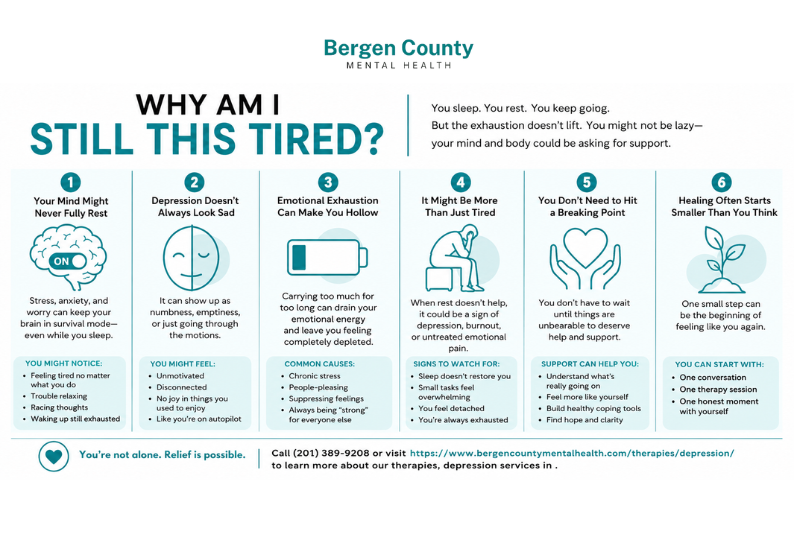
Healing Often Starts Smaller Than People Expect
You do not need to have the perfect words before asking for help.
You don’t need certainty either.
Some people begin with one therapy appointment. Others begin by admitting to someone they trust that they haven’t been okay for a while. Small steps still count.
There’s a moment many people experience before healing starts. Not a dramatic breakthrough. Just a quiet thought:
“I can’t keep pretending this level of exhaustion is normal.”
That moment matters more than you think.
Call (201) 389-9208 or visit our depression services to learn more about our therapies, depression services in New Jersey.