


You’re not falling apart.
But you’re also not okay—and you know it.
From the outside, everything still works. Inside, it’s starting to feel like you’re carrying something heavy… all the time.
Early on, I often point people toward options like an intensive outpatient program because what you’re feeling doesn’t always need crisis-level care—but it does need more than once-a-week conversations.
The effort is becoming the problem
High-functioning clients rarely walk in saying, “I can’t cope.”
They say things like:
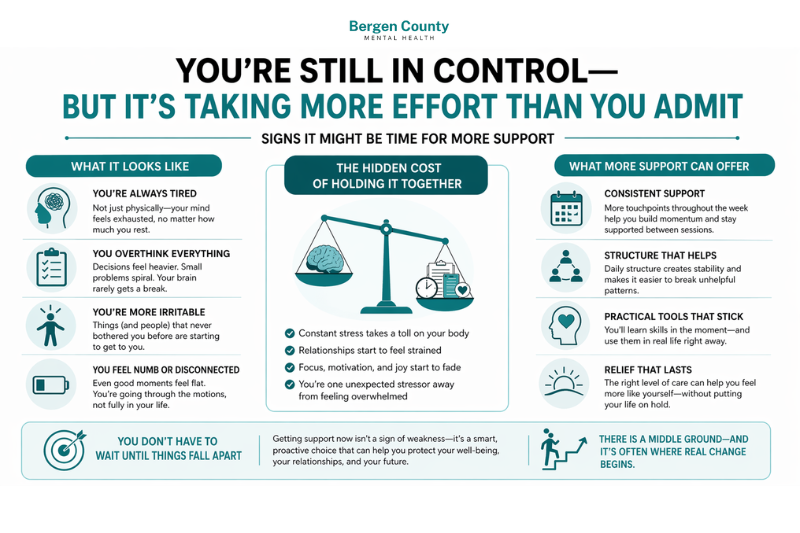
- “I’m just tired all the time.”
- “I can’t shut my brain off.”
- “I’m doing everything right, but it’s not helping.”
What they’re really describing is sustained effort.
You’re managing your anxiety. Containing your mood. Staying productive. Showing up.
But it’s manual now. Forced.
For many people, recognizing that exhaustion early is what leads them to explore how revisiting anxiety treatment helps you reset life before burnout becomes even harder to manage.
And that’s the shift most people miss—the moment where functioning starts requiring more energy than you actually have.
You’ve outgrown weekly therapy—but you haven’t named it yet
There’s nothing wrong with therapy.
But there is a limit to what one hour a week can hold.
If your symptoms are showing up daily—or hourly—that space can start to feel like trying to empty a flooded room with a cup.
This kind of emotional overload can affect the entire household, which is why many families begin exploring how anxiety treatment supports parents in crisis when stress starts impacting daily life.
This is where people begin quietly researching things like day treatment vs therapy without fully understanding what they’re asking.
What they’re really asking is:
“Is there something in between falling apart and just pushing through?”
There is.
What more support actually feels like (not what you think)
Let me be clear—this isn’t about “needing something more intense” in a dramatic sense.
It’s about consistency.
More touchpoints.
More structure.
More opportunities to interrupt the patterns that keep repeating between sessions.
Clients often expect something rigid or overwhelming.
What they experience instead is relief.
“I didn’t realize how much I was holding alone until I wasn’t anymore.”
That’s the difference.
Sometimes that realization begins with accepting that you’re allowed to need more support than you thought, especially when carrying everything on your own has become exhausting.
You’re not losing control—you’re compensating
One of the biggest misconceptions I hear:
“If I were really struggling, I wouldn’t be functioning like this.”
That’s not true.
High-functioning people don’t lose control—they overcompensate.
You work harder.
Think more.
Push through longer.
And because it’s working just enough, it delays getting the right level of support.
But here’s the reality:
The goal isn’t to wait until things break.
The goal is to stop needing this much effort to stay okay.
The hidden cost of “holding it together”
There’s always a cost.
It shows up as:
- Emotional numbness
- Irritability you can’t explain
- Difficulty being present, even in good moments
- Exhaustion that sleep doesn’t fix
You may still be succeeding on paper.
But your internal experience is getting narrower.
Life starts to feel like something you manage instead of something you live.
For people who have struggled to stay consistent with support in the past, learning how IOP supports clients who keep disappearing can make structured care feel more approachable and sustainable.
That’s usually when people start considering more structured care—even if they don’t say it out loud yet.
There’s a middle ground—and it’s often where change happens
You don’t need to crash to qualify for more support.
And you don’t need to commit to something extreme to get relief.
There’s a middle space where you can:
- Stay in your life
- Keep your responsibilities
- And still get consistent, meaningful support
For many people in New Jersey, that looks like finding structured care that meets you where you are, not where things might fall apart.
If you’ve been quietly searching for something more, you’re not overreacting.
You’re noticing something important.
Sometimes that awareness begins with asking why you’re feeling tired all the time, especially when emotional stress, anxiety, or burnout have been quietly building beneath the surface for longer than you realized.
And that matters.
When that quiet strain starts affecting how you show up around others, it can help to explore anxiety treatment for social confidence in a supportive, structured way.
You don’t have to keep doing this the hard way
If this sounds familiar, it’s not because you’re failing.
It’s because you’ve been carrying more than most people realize—for longer than you should have to.
There are options for care in Reclaim Your Mental Health Journey that don’t require you to fall apart first.
You can get support that actually matches the level of effort you’ve been putting in.
Call 201-389-9208 or visit our Intensive Outpatient Program services in New Jersey to learn more about what this level of support can look like for you.