


It’s a quiet kind of panic.
Not loud. Not dramatic. Just a sinking thought: “I had 90 days… and I still ended up here.”
If that’s where you are, I want you to know something clearly—what happened matters, but it doesn’t mean what you think it means. And it doesn’t close the door. Not even close.
Early in this process, many people start exploring more structured support like a partial hospitalization program—not because they’ve failed, but because we’re starting to see the full picture.
We’re Not Just Looking at the Relapse—We’re Looking at the Pattern
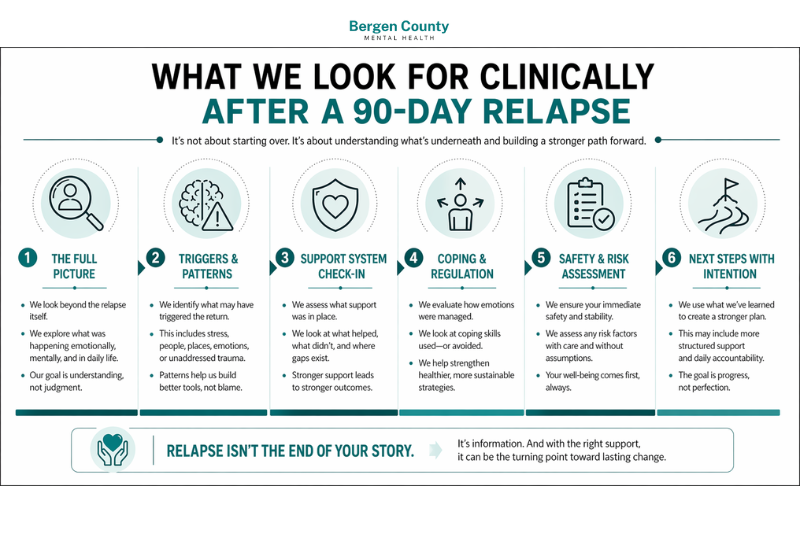
Clinically, a relapse after 90 days tells us something important.
Not about your worth. Not about your effort.
It tells us there may be something underneath that didn’t fully resolve. Understanding why stress and anxiety often show up before a relapse can help you spot the pattern early.
Sometimes it’s:
- Emotional overwhelm that built quietly over time
- Old coping patterns resurfacing under stress
- A gap between insight and real-life application
We’re not asking, “Why did you mess up?”
We’re asking, “What did this reveal that we can actually work with?”
That shift matters.
Progress Doesn’t Cancel Out Because You Slipped
There’s a belief that progress is fragile. That one mistake erases everything.
That’s not how the brain—or healing—works.
Those 90 days still happened. Your nervous system experienced something different. You built awareness. You interrupted patterns, even if not permanently.
Relapse doesn’t delete that.
It adds context to it.
Sometimes the return isn’t starting over. It’s coming back with better information.
What We Pay Close Attention to After 90 Days
At this point, the clinical lens gets sharper—not harsher.
We start noticing:
- How quickly symptoms escalated before things unraveled
- What support systems were in place—and where they broke down
- How you responded internally (shame, avoidance, isolation)
- What didn’t feel sustainable, even if it looked “successful” on the outside
This is where surface-level coping stops being enough.
We begin looking at structure.
Why More Structured Daytime Support Often Comes Next
For many people, the next step isn’t going backward—it’s going deeper.
That’s where structured daytime care comes in.
Not as punishment. Not as “you couldn’t handle it.”
But as a way to:
- Stabilize quickly without removing you from your life completely
- Build consistency during the most vulnerable parts of the day
- Work through what actually triggered the return, not just manage symptoms
This is why many clinicians recommend options like mental health day treatment nj programs after a relapse at this stage. It creates a middle ground—more support than weekly therapy, but still connected to your real world.
The Part No One Talks About: Shame Can Keep You Stuck Longer Than the Relapse
Relapse is painful. But shame is what turns it into something heavier.
Shame says:
- “Don’t go back—they’ll judge you.”
- “You already proved you can’t do this.”
- “You’re behind now.”
None of that is clinically useful. And none of it is true in the way it feels.
From where we sit, the people who come back after 90 days aren’t starting from zero. They’re often closer to real change—because now we’re working with honesty, not just effort.
Coming Back Isn’t a Step Back—It’s a Different Kind of Step Forward
There’s a version of you that made it 90 days.
That version didn’t disappear.
It just ran into something it wasn’t fully equipped to handle yet. Viewing your exhaustion through a different lens can reveal what your body has been trying to say.
That’s fixable.
That’s treatable.
That’s exactly where good care steps in.
If you’re thinking about what comes next, it might help to explore treatment options in New Jersey that offer more support without starting your life over.
You Don’t Have to Figure This Out Alone
There’s nothing weak about needing more structure.
There’s something honest about recognizing it.
Call 201-389-9208 or visit our Partial Hospitalization Program services in New Jersey to learn more about what the next step can look like.