


You’re still getting up. Still answering emails. Still showing up.
But underneath that, something’s off—and it’s getting harder to carry alone.
If you’ve started looking into options like intensive outpatient program services, you’ve probably run into a confusing question: how much help is enough… without stepping away from your life completely?
Let’s talk about that honestly.
The Quiet Exhaustion No One Sees
From the outside, things might look fine. You’re functioning. Responsible. Reliable.
But inside, it feels like you’re running on fumes.
Depression doesn’t always stop your life—it just makes everything heavier. Work takes more effort. Conversations feel forced. Even rest doesn’t really recharge you.
That’s usually the moment people start wondering if they need more support—but not that much support.
The Middle Ground Most People Don’t Talk About
There’s a gap between weekly therapy and full-day structured care.
And if you’re working, that gap matters.
Some people need a higher level of support than a once-a-week session—but stepping away from work entirely isn’t realistic. Financially, professionally, or personally.
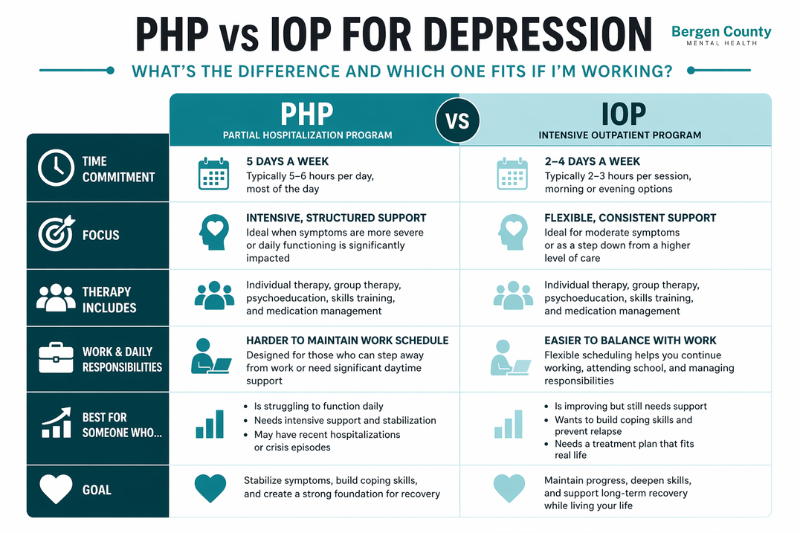
This is where understanding the PHP vs IOP difference starts to matter—not in a clinical way, but in a real-life way.
It’s less about definitions, more about:
How much of your day can you realistically give to getting better?
When Your Days Feel Too Full for Full-Day Care
Structured daytime care (often several hours a day, most weekdays) can be incredibly helpful.
But it’s also a big commitment.
If your job doesn’t allow flexibility—or if stepping away would create more stress—it can feel like an impossible option. Not because you don’t need help… but because your life doesn’t pause.
That doesn’t make you less serious about getting better.
It just means you need something that fits into your reality.
When You Need More Than “Just Talk About It”
Weekly therapy can feel like trying to put out a house fire with a glass of water.
You leave sessions feeling understood—but not necessarily supported enough between them.
Multi-day weekly treatment (usually a few hours, several days a week) gives you more consistent support without taking over your entire schedule.
It creates space to actually work through things—without asking you to disappear from your life.
A Quick Way to Think About It
Here’s a simple, real-world breakdown:
| If your life feels like… | You might need… |
| Completely unmanageable, hard to function daily | More intensive, daytime-level care |
| Manageable on the surface, but internally overwhelming | Flexible, multi-day weekly support |
| Stable but struggling occasionally | Weekly therapy |
There’s no “right” answer here.
Just what actually works for you right now.
You’re Allowed to Want Help That Fits Your Life
A lot of high-functioning people delay getting help because they think:
- “It’s not bad enough yet.”
- “I should be able to handle this.”
- “I can’t step away from work.”
But here’s the truth:
You don’t have to fall apart to deserve real support.
There are treatment options in New Jersey that are designed for people exactly in your position—people who are still showing up, but quietly struggling.
The Decision Isn’t About Strength—It’s About Sustainability
White-knuckling your way through depression while working isn’t strength.
It’s survival.
And survival gets exhausting.
The goal isn’t to prove you can handle it alone.
It’s to find a way to feel better without breaking your life to do it.
You Don’t Have to Figure This Out Alone
If you’re stuck trying to decide what level of care actually fits your life, that’s a normal place to be.
Call 201-389-9208 or visit our Intensive Outpatient Program services in New Jersey to learn more about your options and what might realistically work for you.