


You stopped showing up. Maybe it was one day. Maybe it was a slow drift. Either way, the momentum disappeared and now it feels like the door back is closed. It’s not.
At Bergen County Mental Health, we want to say this clearly: You’re still welcome. No explanations required. Here’s how to come back after walking away from a multi-day weekly treatment and why it’s more than okay to try again.
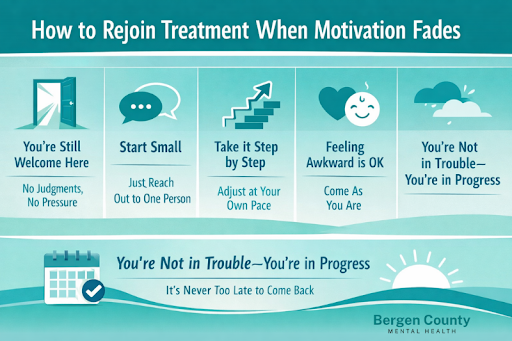
You Don’t Have to Earn Your Way Back
There’s a lie people carry around after they stop showing up:
“I blew it. They probably don’t want me back.”
That voice in your head? It’s shame talking.
We’re not interested in that voice. We’re interested in you.
Re-entering treatment isn’t about “making up for” missing days. It’s about getting support that fits who you are now, not who you were when you stopped. Our door doesn’t close. If it’s been a week, a month, or longer, you’re not behind. You’re on pause. And that pause can end today. For many people, reconnecting with support can begin with finding a therapist in Bergen County who understands where they are emotionally and what kind of care they need now.
Expect Awkward Feelings and Come Anyway
You might feel weird walking back in. Will they ask where you’ve been? Will the group judge you? Will the staff remember?
Yes. Maybe. Probably.
But it won’t be the way you fear.
People who’ve walked this path know that disappearing happens. Mental health isn’t linear. Motivation wavers. Burnout hits. Sometimes survival mode takes over and group sessions feel like too much—often tied to common relapse triggers that can pull you away from support. No one’s keeping a scorecard. The hardest part is walking through the door again, and once you do, the awkwardness fades fast.
Start with One Honest Conversation
Coming back doesn’t require a grand speech. Just a single step:
Tell one person you’re thinking about returning.
That could be:
- A past therapist
- An intake coordinator
- A support person
- Even a front desk email
You don’t have to explain everything. Just say:
“Hey. I want to come back. I don’t know where to start.”
For some people, choosing iop feels like a manageable way to reconnect with support while still maintaining parts of their everyday routine.
We’ll meet you right there. No lectures. No guilt trips. Just the next right step.
Your New Starting Point Might Be Different and That’s Okay
You might not go back into the exact group or schedule you had before. And that’s not a punishment, it’s a reflection of where you are now.
Re-entry could look like:
- A short check-in with a therapist to recalibrate
- A few individual sessions before rejoining group
- Adjusting your schedule for work, family, or energy level
You’re not being asked to “make up” for missed time. Sometimes the most important part is learning what to know before you try to fix your mental health all at once, especially when you’re returning after feeling overwhelmed. We’re focused on what helps now. You get to build something that fits.
If Motivation Is Still Missing, Let Us Help You Find It
Motivation doesn’t always come first. Sometimes it comes after the action.
If you’re still unsure whether you’re “ready,” consider this:
- Readiness isn’t a feeling. It’s a direction.
- You can be unsure and still take one step.
- You don’t need full clarity—you just need curiosity.
We can help you remember what brought you in the first time. Or discover new reasons to stay. That’s part of the work.
No One Is Mad at You
This might be the most important thing to hear:
No one is mad at you.
Not for ghosting. Not for disappearing. Not for struggling.
You’re a human being, doing your best, in a world that often makes healing hard.
Coming back isn’t a confession, it’s a reconnection.
You don’t owe anyone an explanation. But you do deserve support.
Let’s Make the Return Easy
Whether you’re ready to rejoin a multi-day weekly treatment program or just want to test the waters again, you don’t have to figure it out alone. We’ll walk with you, no shame, no judgment, just the next right step.
If you’re looking for mental health support in New Jersey, we’re here and we never closed the door.
📞 Ready to Reconnect?
Call 201-389-9208 or visit our Intensive Outpatient Program services to learn more about how to return to care.