


There was a time when anxiety felt urgent — loud, insistent, impossible to ignore. You learned the tools. You worked with clinicians. You made progress. You marked milestones and watched your life expand in ways that once felt unimaginable.
And then life happened.
Maybe the skill you used to soothe your nervous system doesn’t work like it used to. Maybe uncertainty feels heavier these days. Maybe responsibilities, relationships, or old patterns reemerged in ways that feel strangely familiar. Maybe you’re stable on the outside — paying bills, showing up to work, keeping appointments — but on the inside you feel hollow, auto‑pilot, like you’re watching life instead of living it.
If that resonates, you’re not alone. Long‑term alumni of anxiety treatment sometimes hit a plateau. They’ve done the work they needed to do before — and yet they find themselves feeling “stuck” or disconnected from the parts of life they once cared about most.
Revisiting your anxiety treatment journey isn’t a step backward. It’s a reset — a chance to deepen understanding of yourself, update your tools to the life you’re living now, and reconnect with meaning and presence.
This isn’t about judgment or perfection. It’s about clarity and growth.
Let’s walk through what that reset can look like, why it matters, and how it supports a life of depth — not just stability.
Sometimes the Tools That Helped You Before Become Small
In early treatment, the skills you learned were designed to help you survive — to pull you out of panic loops, intense fear, emotional overwhelm, avoidance patterns.
Those tools are powerful. And they work.
But as life changes — more responsibilities, complex relationships, new stressors, different challenges — those same tools can start to feel too light for what you’re carrying now.
You might notice:
- The breathing exercises calm you briefly, but tension returns more quickly
- Grounding feels like a band‑aid on a tension that’s deeper than the surface
- Self‑awareness becomes a mental exercise rather than lived presence
- Emotional regulation feels controlled rather than felt
That’s not failure. It’s evolution.
Your nervous system is still learning — it hasn’t stopped needing care just because symptoms are less dramatic now.
Revisiting anxiety treatment helps you update your toolkit — not because you lost what you learned before, but because you and life have changed since then.
Healing Isn’t Linear — It’s a Spiral
You didn’t go from untreated to “done.” You developed skills, learned patterns, and built stability. That’s huge. But human experience isn’t a straight line. It’s more like a spiral — you revisit familiar territory, but with new awareness, depth, and insight.
Early treatment gave you survival skills. Later treatment gives you living skills.
In the beginning, you learned how to manage fear.
Now, you learn how to engage with life.
This shift may show up as:
- A desire for meaningful connection rather than just comfort
- A hunger for depth, not just calm
- A wish to integrate your inner life with your outer life
- A sense that there’s more to grow into — not just recover from
Anxiety treatment offers a structured space for that evolution. It’s not about going back. It’s about going forward with more clarity.
You Deserve a Reset — Not a Redo
Here’s a subtle but important truth:
Revisiting anxiety treatment isn’t a redo of old work. It’s a reset — like adjusting your compass when you realize you’ve been navigating a new terrain.
In early recovery, the objective was: get safe.
In this stage, the objective is: get present.
Your nervous system learned to survive; now it can learn to thrive.
That means moving from coping strategies to contextual strategies — tools that help you:
- Understand how current stressors differ from old ones
- See how patterns are showing up now, not then
- Connect emotional experience to daily life in real time
- Renegotiate relationships with your body, thoughts, and environment
You’re not fixing what was broken. You’re refining what works.
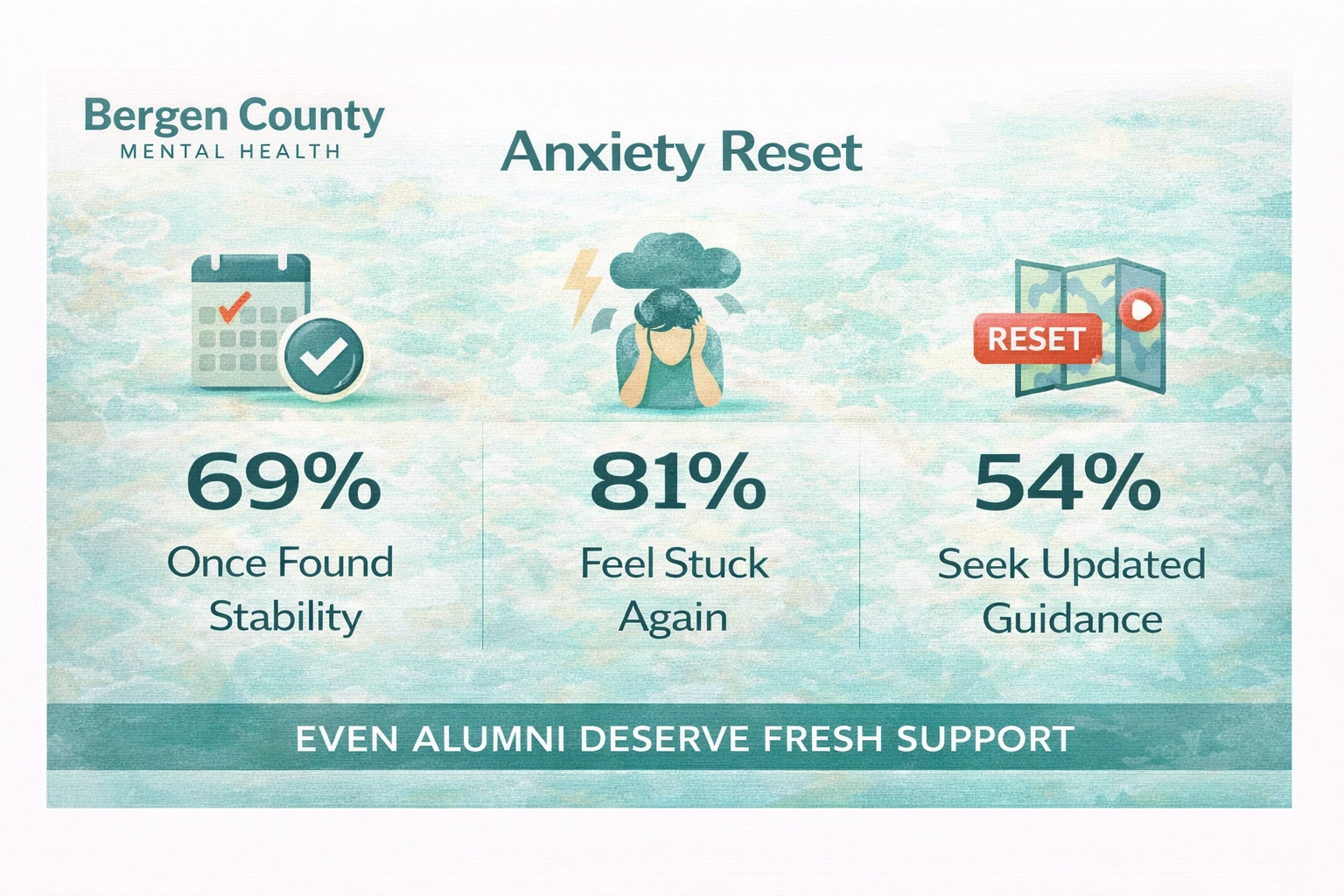
When You Feel Stuck Despite Stability
Long‑term alumni sometimes describe their experience like this:
“I’m not back where I was — I’m just… not where I hoped to be.”
Stability is not the same as fullness. You can be functional without feeling alive. You can be responsible without feeling connected. You can be productive without feeling present.
In treatment, you can explore:
- Why life feels heavy even when nothing seems objectively wrong
- What parts of your inner world you’ve been avoiding
- How emotional signals are showing up in your body
- What fear looks like now disguised as routine
Anxiety doesn’t always roar. Sometimes it whispers. And long after its loudest moments are gone, that whisper can shape your life without you noticing.
Treatment helps you hear the whisper clearly — not as a threat, but as a signal.
Revisiting Anxiety Treatment Helps You See What You Can’t See Alone
Humans are notoriously bad at seeing their own blind spots.
You might think:
- “I should have this all figured out by now.”
- “If I needed help again, that means I failed.”
- “This is just life being hard, not anxiety.”
But inner patterns become habits, and habits are invisible until you view them from a new vantage point.
Anxiety treatment gives you that vantage:
- A clinician reflecting back your patterns
- A space for honest exploration without judgment
- Guidance on where your emotional awareness stops and your avoidance begins
- Coaching on how to navigate current life demands with skill
It’s not repeating old work. It’s seeing your life with fresh eyes.
The Intersection of Anxiety and Purpose
When you were deep in early treatment, the focus was on reducing distress. That was essential.
Now, the focus can shift toward meaning.
You might find yourself asking:
- What do I want life to feel like, not just not feel like?
- What parts of myself am I still withholding?
- Where do I want to invest my energy now?
- What do I want to feel connected to again?
Anxiety treatment doesn’t just alleviate discomfort. It helps you align with what matters. When you address anxiety not as a problem to be reduced but as a pathway to deeper living, recovery becomes your ally — not just stability.
How Your Brain and Nervous System Evolve Over Time
Your nervous system doesn’t reach a plateau and stay there. It continues to adapt to new stressors, new environments, new relationships, and new roles.
Maybe:
- You’re parenting differently
- You’re working longer hours
- You’re navigating identity changes
- You’re facing uncertainty you didn’t plan for
Your nervous system responds to that. Even subtle stress can re‑shape your emotional baseline.
Revisiting anxiety treatment gives you tools to work with your nervous system in your current context, not the context you were in years ago.
It’s like recalibrating a compass — because your destination matters.
How Treatment Helps You Move From Coping to Creation
Early treatment was about coping.
Later work is about creation.
Creation means:
- Building a life you genuinely enjoy
- Noticing what brings you alive
- Responding instead of reacting
- Balancing ambition with presence
- Choosing connection over avoidance
When you revisit treatment, you get support for this deeper work. You’re not just managing symptoms. You’re crafting your life.
This can be subtle, beautiful, transformative work.
A Metaphor: Emotional Fitness Is Like Physical Fitness
When you start exercising physically, the early goals are simple:
- Build endurance
- Reduce pain
- Learn basic movements
Once you’ve achieved those, the work evolves:
- Strength training
- Flexibility
- Balance
- Skill advancement
Your emotional life is similar. Early treatment built endurance — you survived. Later work builds strength, balance, and skill. That’s what revisiting anxiety treatment supports.
It’s not about repeating the basics.
It’s about advancing your emotional ability.
You Don’t Have to Wait for a Breakdown to Seek Clarity
Some people think:
- I’ll go back if I fall apart.
- I’ll revisit treatment when it gets unbearable.
- I’ll wait until I have a crisis.
Here’s the truth:
You don’t need a crisis to deserve support.
You deserve growth. You deserve presence. You deserve clarity. You deserve a life that’s not just liveable but felt.
Revisiting your anxiety treatment journey is not an admission of failure.
It’s an expression of commitment to yourself.
How to Know You’re Ready
You might be ready to revisit treatment if you notice:
- Emotional flatness despite outward success
- Subtle avoidance patterns creeping back
- A sense of “going through the motions”
- Difficulty enjoying life without external validation
- A feeling of disconnection from yourself or others
These are not reasons to worry. They are signals that you’re ready for the next layer of healing.
Treatment helps you turn those signals into direction.
A Reminder: You Are Not Alone
Your journey has value. Your progress matters. And your desire to grow deeper doesn’t mean you did anything wrong.
You’ve already showed up once. That counts.
Now you’re ready to show up again — not because you failed, but because you’re evolving.
Call (201) 389-9208 to learn more about our Anxiety Treatment services in in Bergen County, New Jersey.
Healing isn’t linear. It’s full of spirals.
And sometimes coming back around leads you somewhere you never saw coming — but needed all along.
FAQs: Revisiting Anxiety Treatment After Years of Stability
1. Is it normal to feel stuck after years of successful anxiety management?
Yes. Anxiety can evolve over time, and what helped you years ago may feel insufficient now. Revisiting treatment helps you adapt to new life stages.
2. Will revisiting treatment erase the progress I’ve already made?
No. Your past progress remains valid. Treatment now builds on that foundation with deeper awareness and updated tools.
3. Do I have to re‑tell my entire history?
Not at all. Clinicians focus on your current experience and how patterns show up now — not just what happened in the past.
4. How soon will I notice changes?
Many people notice increased clarity, calm, and presence within a few sessions. Deeper transformation grows with consistent engagement.
5. What if I’m afraid treatment will just bring up old anxiety?
That’s a valid fear. Good treatment is paced and safe. You won’t be pushed; you’ll be supported — and you’ll learn how to face discomfort with strength, not fear.