


I didn’t see it coming.
Not really. I thought I had enough insight, enough tools, enough intention. But one stressful shift, one emotional hit too many, and suddenly I found myself back where I swore I’d never return. I felt like I had erased months of progress in a single moment.
Relapse hit like a tidal wave — sudden, overwhelming, and deeply shameful. I walked away feeling less like someone whose life got derailed and more like someone whose whole story had been canceled.
But here’s what I learned — you can reset a story without rewriting your identity. Your relapse is a chapter, not the ending. And addressing what lies beneath the urge — especially the anxiety that often comes with relapse — can help you build what comes next in a way that’s real, sustainable, and deeply human.
That’s where anxiety treatment can help — not as a punishment or a reset button, but as a foundation for the next stage of your recovery. At Bergen County Mental Health, we see people just like you move through relapse and find grounding, clarity, purpose, and resilience on the other side.
The Weight of Relapse: More Than a Moment
Relapse isn’t just a moment.
For many people, it feels like a verdict — a proof of unworthiness, failure, inability to change.
But relapse doesn’t make you less worthy. It doesn’t mean the work you did before is erased. It means there’s a deeper layer of your internal experience that’s still uncharted.
Sometimes, relapse follows stress before relapse patterns that quietly build over time, such as:
- Unresolved stress
- Patterns of avoidance
- Emotional overwhelm
- Unprocessed fear
- Internalized shame
Anxiety treatment helps you understand these patterns, not just react to them. It gives you language, structure, and tools to make sense of what’s been driving you from the inside out.
Relapse isn’t the end. It’s an opportunity for deeper work.
Why Anxiety Is Often a Partner to Relapse
We often think relapse is about willpower or weakness.
But most relapse isn’t about a lack of desire for recovery — it’s about a biology of avoidance.
Anxiety doesn’t exist in your mind alone.
It lives in your nervous system.
When your nervous system is on high alert, your body and brain are trying to keep you safe — even if the strategies it defaults to are unhealthy.
Before relapse, many people experience:
- Persistent worry
- Emotional numbing
- Tension or agitation
- Sleep disruption
- Sense of dread or unease
These are not character flaws. They are biological stress responses.
Anxiety treatment teaches you to recognize the body’s alarm system for what it is—not as an enemy, but as a signal that something deeper needs attention. That’s where the benefits of returning to anxiety treatment become clear, helping you interrupt patterns before they lead back to relapse.
We Don’t Treat Relapse. We Treat the Human Behind It
If you’ve relapsed, you don’t need someone to lecture you.
You need someone to help you think clearly again.
Anxiety treatment helps you:
- See the triggers without shame
- Understand emotional patterns
- Respond skillfully instead of reacting
- Build tolerance for discomfort
- Reconnect with your goals
You are not your relapse.
You are a person responding to stress with the tools you had at the time. Now you get to learn new tools.
And that changes everything.
Understanding the Body’s Role in Anxiety and Relapse
Anxiety isn’t just thoughts.
It’s a physical experience.
When you relapse, your brain and body often interpret that as danger. Your nervous system shifts into a survival mode that says:
- “I’m unsafe.”
- “I can’t trust myself.”
- “Better numb this felt experience.”
Anxiety treatment helps retrain that response.
We teach clients how to:
- Notice early physical cues
- Use breath work to down‑regulate panic
- Practice grounding to interrupt spirals
- Reframe triggers without guilt
Instead of your body leading with fear, it begins to respond with regulation and clarity.
This shift is what helps prevent repeated relapse — not willpower, not shame, but skills.
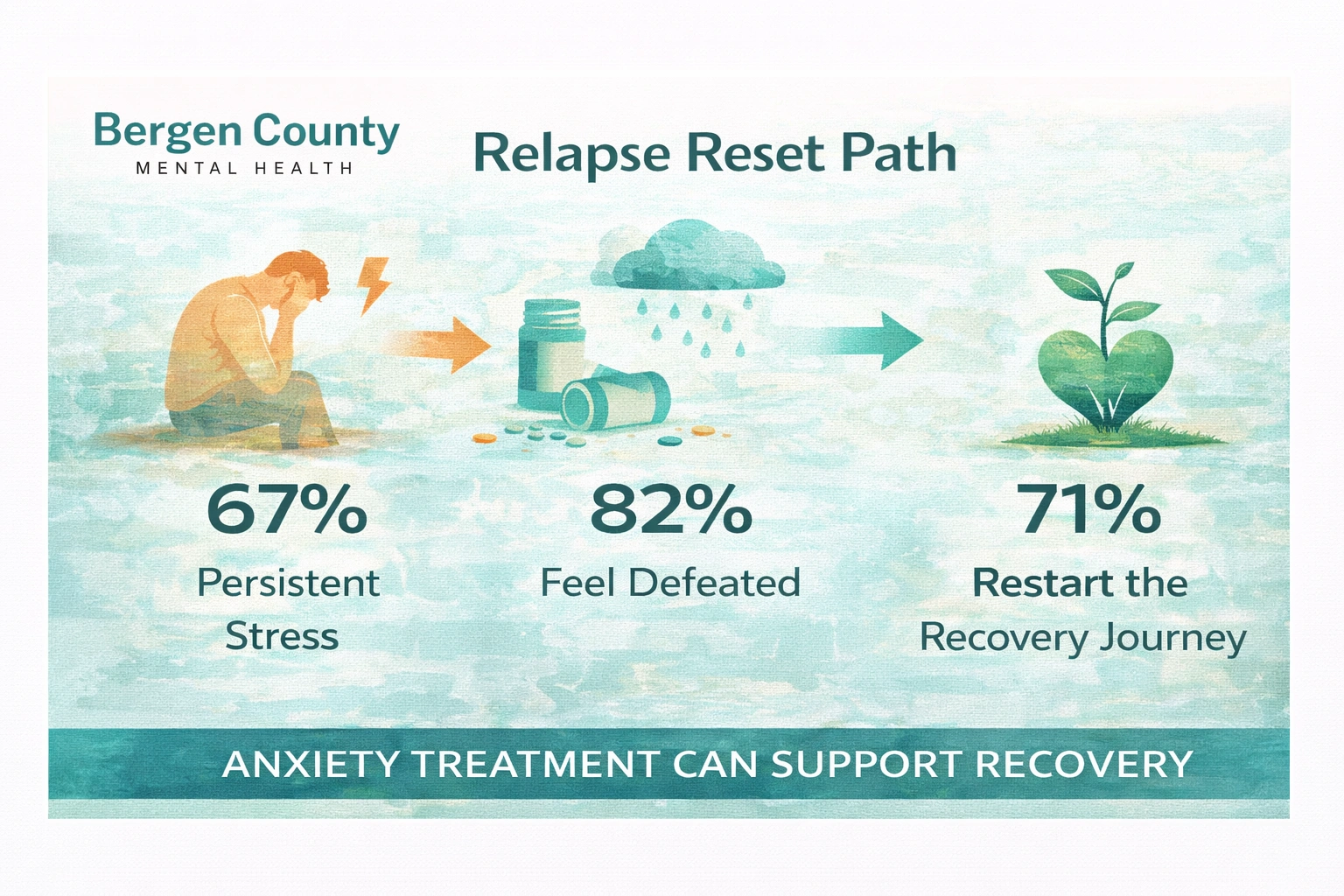
Emotional Regulation: The Heart of What Comes Next
After relapse, the emotional world feels raw. It’s like everything is closer to the surface — tender, reactive, unpredictable.
You might feel:
- Guilt
- Shame
- Anger
- Confusion
- Exhaustion
These emotions are not failures. They are indicators of where your internal world needs support.
Anxiety treatment helps you:
- Identify emotions without judgment
- Notice how emotions show up in your body
- Create space between feelings and reactions
- Communicate with clarity instead of avoidance
This is emotional regulation — one of the most foundational skills in lasting recovery.
When you can feel without fear, you live without constant avoidance.
Rebuilding Confidence After Relapse
One of the most painful pieces of relapse is the self‑doubt it breeds.
You might think:
- “I messed up again.”
- “I can’t trust myself.”
- “I’m always going to struggle.”
- “Maybe I never really meant it.”
But confidence isn’t something you either have or don’t.
It’s something you build — step by step, skill by skill.
Anxiety treatment helps you rebuild confidence by:
- Celebrating resilience, not perfection
- Noticing small wins you missed before
- Reframing setbacks as information — not identity
- Developing ability instead of validation dependency
Confidence grows not when fear disappears — but when you learn to respond differently to fear.
You Never Relapsed Alone
Another layer that makes relapse so lonely is the internal voice that says:
- “No one understands.”
- “I’m the only one who messed up this way.”
- “They’ll judge me.”
But here’s the truth:
Relapse is common.
You are not singular in this experience.
Many people have stepped backward and then gone forward with more strength than before.
Anxiety treatment connects you with professionals and peers who get the complexity. You’re not rewriting your story in isolation — you’re writing it with support.
That’s powerful.
What Comes Next Isn’t Starting Over — It’s Leveling Up
After relapse, it’s tempting to think:
“I have to erase everything and start from zero.”
But that’s not how healing works.
You don’t erase history. You integrate it.
Your past efforts, your struggles, your awareness — they’re all part of who you are.
Anxiety treatment helps you:
- Build new skills on top of old choices
- Transform fear into understanding
- Create a life worth living sober
- Navigate triggers with resilience
- Turn relapse into data, not defeat
This isn’t starting over. It’s leveling up.
A Safe Space to Reconnect With Yourself
Anxiety treatment offers something rare:
A place where you can feel without being overwhelmed,
think without being judged, and
grow without being rushed.
It’s not therapy for “broken people.”
It’s therapy for real people whose nervous systems got tuned to survival.
It helps you:
- Slow down the internal chaos
- See patterns instead of spirals
- Build relationships with support, not avoidance
- Translate internal experience into actionable insight
This is the soil where lasting recovery grows — not in denial, not in shame, but in understanding.
Relapse Isn’t Regression
People often call relapse a regression.
But if you look closely, it’s actually a pivot point.
Regression suggests going backward.
But after relapse — when you do the real work — you’re going forward with more awareness than before.
You have:
- Knowledge of your triggers
- Insight into your stress responses
- Experience of what doesn’t work
- Motivation to build new skills
That’s not backward movement — that’s data.
Anxiety treatment helps you use that data wisely.
You Don’t Have to Wait for the “Perfect” Moment
Many people tell themselves:
- “I’ll try again when I’m ready.”
- “I’ll start treatment when I’m calmer.”
- “I’ll come back when I feel less ashamed.”
Those moments rarely show up on their own.
The perfect moment is a myth.
Healing happens when you show up — even when you’re uncertain, even when you’re afraid, even when you’re not “ready” in your mind.
Anxiety treatment doesn’t wait for perfection.
It meets you where you are — and helps you grow from there.
The Bridge to What Comes Next
Relapse felt like a chasm I couldn’t cross.
But treatment became a bridge — not spanning a void, but integrating the terrain beneath my feet.
Anxiety treatment is that bridge:
- Grounded in understanding
- Built with skillful support
- Designed to withstand stress
- Flexible, not fragile
- Leading to connection, not disconnection
You walk across it not by forcing yourself to be fearless — but by learning how fear actually works.
And that changes everything.
FAQs About Anxiety Treatment After Relapse
1. Will anxiety treatment judge me for relapsing?
No. Clinicians understand relapse as part of many recovery journeys. The focus is on understanding your experience and helping you build skills — not judging your past.
2. Can anxiety treatment help prevent future relapse?
Yes. By teaching emotional regulation, coping skills, nervous system awareness, and response flexibility, treatment helps you better navigate triggers and stress without falling back into old patterns.
3. Is anxiety treatment only for people with diagnosable anxiety disorders?
Not at all. If anxiety interferes with your daily life, relationships, or recovery journey — whether or not there’s a formal diagnosis — treatment can help.
4. How soon can I benefit from anxiety treatment after relapse?
Many people notice small improvements early on — such as feeling more understood, having tools for stress, and reducing internal fear responses — within the first few weeks. Long‑term change grows with consistency.
5. Do I have to talk about everything in my past relapse?
No. You only share what you’re ready to explore. Treatment is paced around your comfort and readiness, not pressure.
Your Story Continues — With More Strength Than Before
Relapse didn’t erase your progress — it illuminated where support was needed next.
Anxiety treatment doesn’t judge your path — it supports your growth.
Call (201) 389-9208 to learn more about our Anxiety Treatment services in New Jersey.
Your relapse was not a reset to zero.
It was a deeper beginning.
And what comes next could be stronger than anything you’ve built so far.