


You love them fiercely, and that’s exactly why it hurts so much when anxiety gets in the way.
Maybe they withdraw when you reach out. Maybe they get irritable over small things. Maybe they say one thing and act another. You’re left confused, worried, and wondering: Are they shutting me out? Or is something deeper happening inside them?
The truth is often the latter.
Anxiety isn’t just a feeling. It’s a nervous system response that can confuse thoughts, distort intentions, and make connection feel risky — even with the people we love most.
At Bergen County Mental Health, we see this all the time. Partners come in loving someone deeply but feeling helpless, misunderstood, or stuck in patterns of tension and worry.
Anxiety treatment isn’t just for the person experiencing anxiety. It’s a tool that helps both partners understand what’s happening beneath the surface — and how to navigate it with care and connection.
Love Isn’t the Problem — Anxiety Is
When anxiety is active, it doesn’t show up as one thing. It shows up as many:
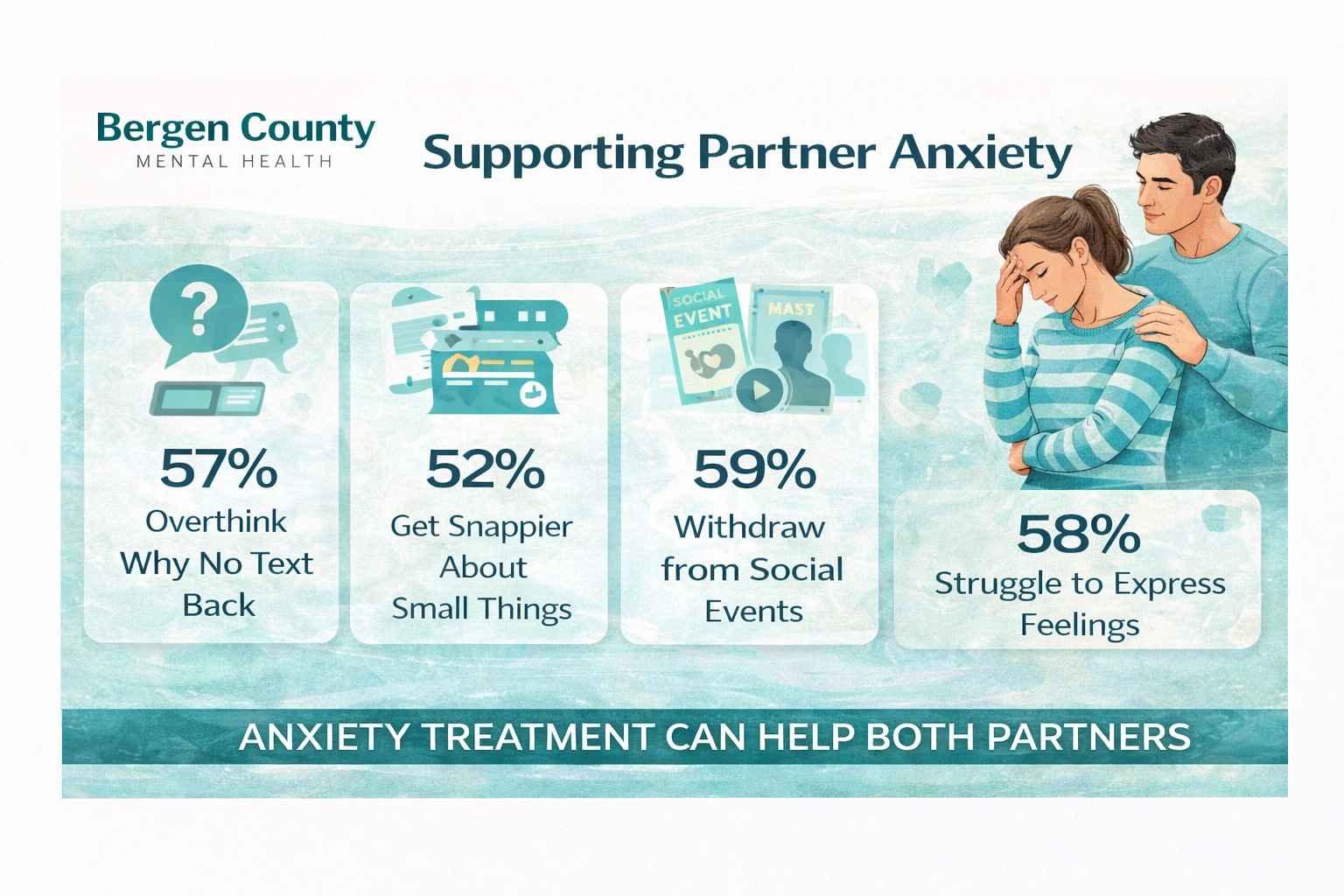
- “Why didn’t you text me back?”
- Pulling away after a good night
- Snapping when you ask a simple question
- Excessive worrying about small details
- Avoiding social or family events
- Exhaustion that sleep doesn’t fix
You might look at these behaviors and think your loved one is shutting you out, being inconsistent, or making things harder than they need to be.
But anxiety doesn’t act that way because someone doesn’t love you. Anxiety distorts how someone perceives stress — it makes threats where there are none, and makes safety feel fragile.
Treatment helps them understand the why of their reactions—not to excuse them, but to heal them. And if you’re unsure how the process begins, understanding what to expect anxiety treatment first visit can make that first step feel far less intimidating.
Anxiety Is a Whole-Body Experience
One of the hardest things for partners to understand is that anxiety isn’t just mental.
It’s physical.
When someone’s brain interprets a situation as threatening — whether it’s a text message, a change of plan, or a social gathering — their nervous system goes into survival mode.
Heart races. Breathing becomes shallow. Muscles tense. Thoughts jump to worst-case scenarios.
For someone with anxiety, this response can happen even when there’s no real danger — simply because their brain has learned to predict threat rather than safety.
In anxiety treatment, clients learn to recognize these bodily signals, understand them, and calm them — rather than reacting with fear or frustration.
And when a partner learns this too, it becomes less of a mystery and more of a shared understanding.
Why Logic Doesn’t Always Work
If your partner is anxious, you’ve probably tried:
- Reassurance
- Logical explanations
- Gentle persuasion
- Encouragement
- Rational reasoning
And watched their fear persist anyway.
That’s because anxiety doesn’t listen to logic when the nervous system is in “survival mode.” It doesn’t care that an argument is unlikely. It doesn’t hear rational corrections when it’s echoing “danger” in the body.
Anxiety works on the nervous system first — and the brain second.
Part of anxiety treatment is teaching clients how to calm the body first, then work with the thoughts. This is why talk alone can feel ineffective. The physical sensations have to be addressed before the mind can truly settle.
Understanding this helps partners know:
It’s not about arguing them out of fear — it’s about grounding them back into safety.
When Their Fear Seems Directed at You
One of the most painful experiences for partners is feeling like anxiety is aimed at them.
Questions like:
- “Why do you always doubt me?”
- “Why does this bring you down?”
- “Why are you upset when I’m just trying to help?”
These can feel personal — and sometimes they do feel personal when anxiety is involved.
But anxiety doesn’t choose a target. It hijacks perception.
Your offer of help can register as pressure. A caring question can feel like criticism. A calm voice can sound like judgment.
In treatment, clients learn:
- How to differentiate fear from criticism
- How to communicate needs without escalating anxiety
- How to interpret intention rather than react to perceived threat
This doesn’t happen overnight. But it does build a bridge between fear-driven reactions and conscious responses.
Anxiety Treatment Teaches Communication Skills That Heal
A lot of relationship strain comes from miscommunication — not a lack of love.
Anxiety treatment helps clients:
- Describe what they’re experiencing without blame
- Ask for what they need in a way partners can hear
- Separate emotions from facts
- Slow down in moments of escalation
- Repair ruptures instead of repeating them
This translates to healthier conversations, less reactivity, and fewer misinterpreted intentions.
And as a partner, you learn how to listen differently — not just to words, but to the emotional and nervous signals behind them.
Boundaries Matter — For Both of You
Supporting someone with anxiety doesn’t mean absorbing every fear or accommodating every avoidance. It means learning how to set loving boundaries that protect connection.
That might look like:
- Agreeing on how to handle conflict
- Establishing space for processing feelings
- Recognizing when one partner needs quiet or time alone
- Creating safe ways to ask for reassurance without frustration
- Clarifying what behavior is supportive — and what is over-functioning
Your partner’s anxiety doesn’t erase your needs. And your needs don’t diminish their experience.
Anxiety treatment equips both partners with tools to balance vulnerability and stability — and helps you grow together rather than apart.
Supporting Someone in Recovery or Sobriety
Anxiety often shows up alongside recovery from substance use, trauma, or chronic stress.
If your loved one is also navigating sobriety, you might see:
- Anxiety triggered by past coping mechanisms
- Situations that remind them of old patterns
- Fear of loss of control
- Worry that others are judging their choices
Anxiety treatment acknowledges these intersections — not as separate issues but as interconnected experiences.
The goal isn’t to “fix” everything at once. It’s to build capacity — the ability to tolerate discomfort without reverting to avoidance or suppression.
And as a partner, learning this helps you become a stable presence, not an enforcer, not a rescuer, but a genuine companion in growth.
When Your Support Feels Like It’s Not Enough
This one hurts.
You show up. You care. You encourage. You validate. And still anxiety looms.
This doesn’t mean you’re failing.
Anxiety is not a deficit in love. It’s a pattern in the brain and body that needs retraining.
Treatment helps your loved one learn how to manage their internal experience — and it helps you understand when your role is support, and when it’s stepping back so they can build their own skills.
It’s not about abandoning care — it’s about strengthening connection with healthier boundaries.
Anxiety Treatment Gives Language to the Invisible
One of the hardest parts of loving someone with anxiety is that so much of it is internal.
You can’t see it.
You can’t touch it.
But you feel its effects.
In treatment, clients learn to:
- Name what they’re feeling
- Identify triggers
- Notice bodily sensations
- Track thoughts
- Speak emotions without blame
This gives language to what used to be internal chaos — and language is the first step toward repair.
When your partner can say, “I’m not upset with you — I’m overwhelmed inside,” that changes everything.
FAQs About Anxiety, Love, and Treatment
1. How do I know if what I’m seeing is anxiety or just personal conflict?
Sometimes it’s both. Anxiety often amplifies normal relationship stress. A therapist can help distinguish fear-driven reactions from intentional behavior.
2. Can anxiety treatment help my relationship directly?
Yes. Many approaches include communication skills and couples-focused work that improves understanding and reduces reactive conflict.
3. What if my partner doesn’t want treatment?
You can’t force someone into therapy, but you can express your care without pressure. Sometimes curiosity rather than confrontation opens the door.
4. Is it okay to get support for myself?
Absolutely. Loving someone with anxiety can be emotionally taxing. Your well-being matters too.
5. How long does anxiety treatment usually take?
It varies. Some people notice changes in a few weeks; deeper shifts often take consistent work over months. The process is personalized, not rushed.
Love Isn’t Enough on Its Own — But It’s a Start
You don’t have to have all the answers.
You don’t have to be unflappable.
You don’t have to erase fear or fix anxiety.
You just need understanding — and the willingness to walk beside your partner as they learn to understand themselves.
Call (201) 389-9208 or Anxiety Treatment services in New Jersey to learn more about how Bergen County Mental Health supports couples and individuals navigating anxiety.
Fear and love can coexist. With the right support, they don’t have to fight each other.